

🔶 WHAT YOU WILL LEARN
- What is Teen Patti Master?
- The Objective of the Game
- Game Setup in Detail
- Blind vs. Seen — The First Decision
- Every Betting Action Explained
- The Showdown - Rules & Outcomes
- Hand Rankings — Full Breakdown
- How a Full Round Flows
- Game Variants - AK47, Muflis & More
- Strategy & How to Think at the Table
- Common Mistakes & How to Avoid Them
- Frequently Asked Questions
♠ What is Teen Patti Master?
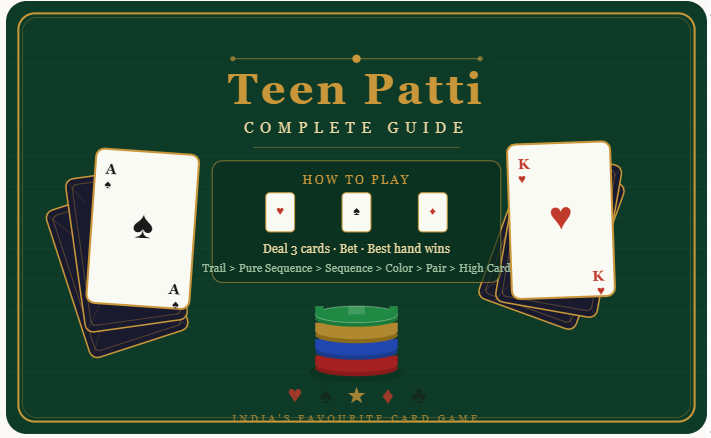
Teen Patti Master is a mobile multiplayer card game built on the rules of Teen Patti — one of the oldest and most widely played card games on the Indian subcontinent. The name “Teen Patti” literally translates to “three cards” in Hindi, which immediately tells you the most important mechanical fact: each player in the game plays with only three cards.
The game uses a standard 52-card deck with no jokers (in the Classic format) and is played between 3 and 6 players at a single table. Unlike poker, where players build five-card hands, Teen Patti’s three-card structure means every single card in your hand has enormous weight. There are fewer possible combinations, but that makes the decisions sharper — one bad card can be the difference between winning and losing the pot.
At its core, Teen Patti Master is a game of three intertwined skills: hand reading (assessing how strong your hand is relative to what opponents might hold), bet management (deciding how much to commit to each round), and psychology (reading what other players’ betting behaviour reveals about their hands). Players who rely on luck alone tend to lose over time. Players who develop these three skills consistently win more than they lose.
The digital version on Teen Patti Master automates all the mechanical tasks — dealing, shuffling, pot management, timer enforcement — so players focus entirely on making decisions. The interface shows you your three cards, the current pot size, what each opponent has bet, and how much you need to call or raise. Everything you need to play is on one screen.
📌 Related Guides :
♥ The Objective of the Game
The objective of Teen Patti Master is to win the pot — the accumulated total of all bets placed by all players during a single round. The pot grows with every Call and Raise made throughout the round, and the entire amount goes to exactly one player at the end.
There are two distinct ways to win the pot, and understanding both of them shapes how you should play every round:
- Win at Showdown with the Best Hand
- When the round reaches a Showdown — which happens when only two players remain — both players reveal their three cards. The player holding the stronger hand according to the hand ranking hierarchy wins everything in the pot. This is the “honest” way to win — you stayed in, paid your bets, and your cards were better.
- Be the Last Player Standing After All Others Fold
- If every other player at the table chooses to fold during the betting rounds, the last remaining player wins the entire pot without revealing their cards at all. This means it is entirely possible — and completely legal — to win a round with the weakest possible hand, simply by staying in when everyone else gives up. This is what creates the bluffing dimension of the game.
These two paths to victory are in constant tension with each other. If you bet too aggressively, you might scare everyone into folding early — winning the pot but leaving money on the table because the pot was small. If you bet too passively, experienced players will keep the pot small and outlast you. The most profitable outcomes come from correctly calibrating your aggression to extract maximum chips from opponents who hold losing hands but believe they can still win.
💡 Key Insight
Your cards matter, but they are not the whole game. What matters equally is how your opponents perceive your cards based on how you bet. A confident raise can carry a weak hand further than a passive call with a strong one.
Game Setup — Everything That Happens Before Play Begins
Every round of Teen Patti Master begins with a setup phase that happens automatically before any player makes a decision. Understanding what is happening in this phase — and why — prepares you to make smarter decisions the moment betting begins.
The Table and Stake Level
When you open Teen Patti Master, you choose a table to join. Tables are categorised by their stake level — the minimum and maximum amount that can be bet per turn. A low-stakes table might have a minimum bet of ₹1 and a cap of ₹1,000 per round. A high-stakes table may start at ₹100 per turn with no ceiling except the table maximum. Choose a table whose stake level is comfortable relative to your current balance. As a general rule, sit down at a table where the maximum possible loss in one round is less than 10% of your total balance.
The Boot Amount (Ante)
Before a single card is dealt, the app automatically collects a small fixed bet from every player at the table. This is called the boot amount — also referred to as the ante. It is mandatory, non-negotiable, and equal for all players. Its purpose is to seed the pot: every round begins with money already in the middle, giving every player an immediate financial reason to compete. Even if you plan to fold on your very first turn, the boot is already gone — you cannot get it back by folding early. This is why participating in at least a few betting rounds before folding is often worth considering on borderline hands.
Dealing the Cards
Once the boot is collected, the dealer distributes exactly three cards face-down to every player, one at a time, moving clockwise around the table. In Teen Patti Master, the dealer role is indicated by a small button icon on screen and rotates one position clockwise after every completed round. The dealer does not have any special power over the game in Teen Patti — unlike some poker variants — but the position matters because betting begins from the player immediately to the dealer’s left, meaning the dealer acts last in each round.
On Teen Patti Master specifically : The dealing is handled instantly by the app. You will see your three cards appear on screen face-up (visible only to you). Opponents' cards appear face-down. The pot counter at the centre of the table shows the current boot total, and the betting phase begins automatically once all cards are distributed.
♣ Blind vs. Seen — The Most Important First Decision
Before you make your first bet, you face the single most strategically significant decision in Teen Patti Master: will you be a Blind player or a Seen player? This choice is made individually — different players at the same table can make different choices — and it has immediate, measurable financial consequences for the entire round.
What is a Blind Player?
A Blind player is one who does not look at their three cards. They place their chips into the pot without knowing whether they hold a Trail of Aces or a useless High Card. In exchange for this uncertainty, the game rewards them with a significant financial advantage: a Blind player only pays half the current stake on every betting turn. If the current stake is ₹10 per turn, a Blind player pays ₹5. If it rises to ₹40, a Blind player pays ₹20.
This cost advantage allows a skilled Blind player to remain in the round much longer for the same total outlay, gathering information about how opponents are betting and applying pressure simply by staying in without reacting to a hand.
What is a Seen Player?
A Seen player has looked at their cards and knows their hand. They pay the full current stake on every betting turn. The knowledge of their hand allows them to make more informed decisions — they know whether to push hard with a Trail or quietly fold a High Card — but they pay twice the cost of a Blind player per turn to have that information.
The Rules That Govern the Relationship Between Blind and Seen
- A Blind player can choose to look at their cards at any point during the round, converting themselves into a Seen player. This is a one-way conversion — once you go Seen, you cannot return to Blind status in that round.
- When a Blind player and a Seen player are compared in terms of stake, the Seen player always pays double what the Blind player pays. If a Blind player bets ₹5, the Seen player must bet ₹10 to match.
- A Seen player cannot request a Sideshow with a Blind player. Sideshows are only between two Seen players.
- At the Showdown, both players must reveal their cards regardless of whether they were Blind or Seen throughout the round. Playing Blind does not exempt you from the final reveal.
Strategic use of Blind play : The most common expert application of Blind play is in the early rounds of a hand when the pot is small and no betting patterns have emerged yet. Staying Blind for the first one or two rounds keeps your cost low while you observe how others bet. Once you have identified which opponents are raising aggressively (likely strong hands or bluffs) and which are calling passively (likely mid-range), you can make an informed decision about whether to look at your cards and commit.
♠ Every Betting Action — Explained in Full
Once cards are dealt, the betting phase begins. Starting from the player to the left of the dealer and moving clockwise, each player on their turn must choose one of five possible actions. These five actions are the complete vocabulary of Teen Patti Master gameplay. Master them and you understand the entire mechanical structure of the game.
STAY IN • NEUTRAL
CALL (CHAAL)Match the current stake and remain in the round. If you are a Blind player, you pay half the current stake. If you are a Seen player, you pay the full current stake. Calling signals to opponents that you are interested in continuing but not strong enough - or not willing — to push. Use Call when your hand is decent but not dominant, or when you are gathering information before committing.
PRESSURE • AGGRESSION
RAISEIncrease the current stake above the minimum. When you Raise, every player still in the round must match your new, higher stake to continue — or fold. Raising is the primary tool for two purposes: growing the pot when you hold a strong hand, and pressuring uncertain opponents into folding. A well-timed Raise on a mid-strength hand can clear the table faster than a slow Call with a strong one.
EXIT • LOSS LIMITATION
FOLD (PACK)Surrender your three cards facedown and exit the round completely. You forfeit all bets you have placed so far in this round, including the boot, but you stop losing any further chips. Folding is always free after your initial contributions - it costs you nothing additional at the moment you fold. The discipline to fold losing hands early is the most underrated skill in the game.
COST SAVING • PRESSURE TOOL
PLAY BLINDContinue into the next betting turn without looking at your cards, paying only half the stake. This is not a separate action so much as a state you remain in until you choose otherwise. Blind play has two concrete benefits: it reduces your per-turn cost by half, and it creates a subtle psychological pressure on Seen players who know you are willing to bet without knowing your hand — implying either confidence or a deliberate bluff.
PRIVATE COMPARISON • ELIMINATION TOOL
SIDESHOW (COMPROMISE)Available only to Seen players. On your turn, you may request a private head-to-head hand comparison with the player who acted immediately before you — provided that player is also Seen. If they accept, both players compare hands privately. The weaker hand must fold immediately. The stronger hand continues in the round. If the request is declined, the round proceeds normally with both players still active. Sideshows are powerful for eliminating specific opponents you believe you can beat.
💡 The Decision Framework for Each Turn
Before acting on your turn, ask yourself three questions in order:(1) Is my hand strong enough to still win this pot?
(2) Is the cost to continue proportionate to what is already in the pot?
(3) What does my action communicate to the remaining players? If your hand is weak, the cost is high, and calling would signal weakness - fold immediately. If your hand is strong, the pot is worth growing, and a Raise serves you - raise with purpose.
How a Full Round Flows — Step by Step
Now that you understand each individual element — setup, Blind/Seen, betting actions, hand rankings — here is how they all connect inside a single complete round of Teen Patti Master. Reading through this sequence once will make the app feel immediately intuitive the first time you play.
-
Step 1 — Boot is Automatically Collected
The moment a round begins, the app deducts the boot amount from every player’s balance and places it in the central pot. The pot counter on screen updates to reflect the combined boot from all players. This happens in under a second and requires no action from any player.
-
Step 2 — Three Cards are Dealt to Each Player
The app deals three face-down cards to every player clockwise. On your screen, your three cards are immediately visible to you. Your opponents’ cards appear as card backs — you cannot see them at any point during the round unless a Sideshow or Showdown is triggered.
-
Step 3 — First Player Acts
The player immediately to the left of the dealer goes first. A countdown timer appears on screen — typically 15 to 20 seconds — within which they must act. They choose: stay Blind and Call, go Seen and decide, Raise, or Fold. Their action sets the initial stake for this round.
-
Step 4 — Betting Proceeds Clockwise
Each subsequent player acts in clockwise order, each facing their own countdown timer. On each turn, the player sees the current stake, how much they must pay to Call, the total pot size, and how many players remain. They choose Call, Raise, Fold, remain Blind, or request a Sideshow. This continues around the table in multiple circuits until players begin folding.
-
Step 5 — Sideshows Occur When Requested
Any Seen player may request a Sideshow against the immediately preceding Seen player on their turn. The app pauses momentarily while the challenged player decides to accept or decline. If accepted, both hands are compared privately by the app and the weaker hand is folded automatically. If declined, the round continues unchanged.
-
Step 6 — Players Fold as Stakes Rise
As the round progresses and the stake per turn increases through Raises, players with weaker hands begin to fold. Each fold removes a player from the round and brings the remaining players closer to the Showdown. The pot continues to grow with every Call and Raise from remaining players.
-
Step 7 — Heads-Up Phase Begins
When only two players remain, the round enters its final phase. Betting continues between these two players until one demands a Showdown, one folds, or the table stake maximum is reached. During this phase, both players can see the pot size and know that every additional bet is directly between them.
-
Step 8 — Showdown and Winner Declared
A Showdown is called. Both players reveal their cards. The app instantly evaluates both hands and declares the winner. The entire pot is credited to the winner’s balance. A brief summary is shown on screen indicating the winning hand type, the winning player, and the pot amount won.
-
Step 9 — Next Round Begins
The dealer button moves one position clockwise. All player balances are updated. A new boot is automatically collected and fresh cards are dealt. The entire cycle restarts. On Teen Patti Master, the gap between rounds is only a few seconds.
💡What Happens if Your Timer Runs Out?
If you do not act within the countdown window on your turn, Teen Patti Master automatically folds your hand. The fold is treated exactly as if you had chosen to fold manually. Always be ready to act before your timer expires - automatic folds at critical moments can be very costly.
♥ Strategy — How to Think at the Table
Rules tell you what you can do. Strategy tells you what you should do. The following principles are not generic gambling advice — they are directly grounded in the mechanics of Teen Patti Master and apply to every round you will ever play.
Principle 1 — Evaluate Your Hand Relative to the Variant, Not in Isolation
A Pair of Jacks is a strong hand in Classic Teen Patti at a three-player table. That same Pair of Jacks in an AK47 round at a six-player table is a mediocre hand at best, because the probability that at least one opponent holds a Trail (via wild cards) is substantial. Before assessing how strong your hand is, always factor in: how many players are at the table, which variant is active, and how the betting so far suggests others are holding.
Principle 2 — Read Betting Patterns, Not Just Cards
You cannot see your opponents’ cards, but you can observe everything about how they bet. A player who raises on the very first turn typically holds either a strong hand or is executing an early bluff to thin the field cheaply. A player who has called passively for five consecutive rounds without raising likely holds a mid-range hand they are uncertain about — they are waiting to see if the pot justifies a bigger commitment. A player who goes Seen very early in a round is often confident in their hand. These patterns are not guarantees, but over multiple rounds at the same table they build into reliable reads.
Principle 3 — Control Pot Size to Match Your Hand Strength
If you hold a marginal hand — say a low Sequence or a medium Pair — your goal is to reach a Showdown as cheaply as possible. Do not Raise. Do not encourage others to stay in with large calls. Call the minimum on every turn and hope the stronger hands knock each other out before the Showdown. Conversely, when you hold a Trail or a Pure Sequence, your goal is to grow the pot as fast as possible. Raise early and confidently. Do not let the pot stay small when you are almost certain to win it.
Principle 4 — The Sideshow is a Surgical Tool
The Sideshow works best when targeted specifically at a player you believe holds a hand slightly weaker than yours. A medium Pair (say, Pair of Sevens) against an opponent you believe holds a low Pair or High Card is an ideal Sideshow scenario. However, never request a Sideshow against a player who has been raising aggressively — if they accept, you are likely beaten. And never request a Sideshow when the pot is very large and you are confident you hold the strongest hand at the table — you want a full Showdown, not an early private exit.
Principle 5 — Manage Your Total Exposure Per Session
This is the most overlooked strategic principle in Teen Patti Master. Decide before you sit down at a table what the maximum amount you are willing to lose in one session is. Stick to that number unconditionally. The nature of the game means variance is high — even expert players can lose five consecutive rounds on hands they played correctly. What separates skilled players from losing ones over time is not winning every round — it is never losing more in one session than they planned to lose.
💡 The Single Highest-Value Habit
After every round — win or lose — ask yourself one question: Given what I knew at the time, was my decision correct? Not whether the outcome was good, but whether the decision was sound. Winning with a bad decision is luck. Losing with a good decision is variance. Track your decision quality, not your short-term results, and your game will improve steadily over time.
♦Common Mistakes and How to Avoid Them
The difference between a beginner and an intermediate player in Teen Patti Master is almost entirely explained by how frequently they make the following mistakes. Recognising and eliminating each one will have an immediate positive impact on your results.
-
01Mistake 1 — Calling Too Much with Weak Hands
The most common and expensive mistake beginners make is calling repeatedly with a High Card or low Pair simply because they have already contributed the boot amount. The boot is a sunk cost — it is gone regardless of what you do next. Every additional Call with a losing hand adds to the loss. The correct response to a weak hand is to fold immediately, not to “try to get the boot back.”
-
02Mistake 2 — Raising Predictably
If you only raise when you hold a Trail or Pure Sequence, experienced opponents will quickly learn that your raises mean you have a premium hand — and they will fold, keeping the pot small every time you hold your best cards. Mix occasional Raises into rounds where you hold mid-range hands to prevent your betting pattern from becoming readable. The goal is to keep opponents uncertain about whether your raise is a premium hand or a calculated bluff.
-
03Mistake 3 — Going Seen Too Early Without Reason
Many beginners look at their cards immediately out of curiosity or impatience. This costs double the chips per turn from that point onward for the rest of the round. Stay Blind in the first one or two turns unless the stakes are rising fast enough that the cost of staying Blind approaches the cost of going Seen, or unless you have a specific strategic reason to need the information of your hand immediately.
-
04Mistake 4 — Demanding Showdown Too Early at Heads-Up
When two players remain, demanding a Showdown immediately before the pot has grown through additional betting is usually a mistake unless you are extremely confident in your hand. If you hold a Trail, a couple of additional rounds of betting before demanding the Showdown can significantly increase what you win. The exception is when your hand is moderate and you fear the opponent might improve their own betting position by continuing.
-
05Mistake 5 — Not Adjusting Strategy Between Variants
Sitting down at a Muflis table and playing with Classic instincts is one of the fastest ways to lose chips. A Trail in Muflis is a fold. Aggressive raising in AK47 with no wild cards ignores the statistical reality that others likely hold wilds. Every variant requires a genuine strategic reset — not just a minor adjustment, but a different evaluative framework entirely.
-
06Mistake 6 — Letting Emotion Drive Betting Decisions
After a string of losses, the instinct is to raise aggressively on the next round to “win it all back.” This is one of the most dangerous states to be in while playing Teen Patti Master. Emotionally driven bets are disconnected from hand strength and table reads — they are simply reactive. If you notice yourself betting based on frustration, take a break. Return when your decision-making is calm and analytical again.