How to Play Indian Rummy (13 Cards) – Rules & Tips 2026
Indian Rummy also called 13 Card Rummy or simply Rummy 13 is India's most widely played skill-based card game. From family evenings to competitive online tables with real cash prizes, the same fundamental rules apply: arrange your 13 cards into valid combinations before your opponents do.
This complete guide covers everything you need from the basic rummy rules for 13 cards to advanced winning strategies, all valid card combinations, point values, Joker rules, and a detailed breakdown of all three major formats.
1. What Is Indian Rummy (13 Cards)?
Indian Rummy is a draw-and-discard card game played with 13 cards per player. It belongs to the Rummy family of games and is closely related to Gin Rummy and Canasta, but with rules and formats that evolved distinctly in India.
The objective is to be the first player to arrange all 13 cards into valid groups — called sequences and sets — and make a valid declaration. It is classified as a game of skill in Indian courts, which is why it is legally played on real-money platforms across most Indian states.
| At a Glance | Detail |
| Game Type | Draw-and-discard skill card game |
| Players | 2 to 6 |
| Decks Used | 1 deck (2 players) or 2 decks (3–6 players), each with printed Jokers |
| Cards Per Player | 13 cards |
| Objective | Arrange all 13 cards into valid sequences and sets and declare first |
| Minimum Requirement | At least 2 sequences, of which 1 MUST be a Pure Sequence |
| Legal Status | Game of skill — legal in most Indian states |
2. What You Need to Play
• 1 standard 52-card deck + printed Jokers for 2 players
• 2 standard 52-card decks + printed Jokers for 3–6 players
• A flat surface or online app (apps handle all dealing automatically)
• Agreed boot amount for Points Rummy, or fixed deal/pool entry fee
3. Indian Rummy Rules — Step by Step
Here is a complete walkthrough of one round of 13 Card Rummy:
Step 1 — Deal 13 Cards to Each Player
The dealer distributes 13 cards face down to every player, one at a time, going clockwise. The remaining cards form the closed deck at the centre of the table. The top card of the closed deck is turned face up to start the open (discard) pile.
Step 2 — Pick the Wild Joker
After dealing, one card is randomly drawn from the closed deck and placed face up under the deck — this card's rank becomes the Wild Joker for that round. Any card of that rank across all suits becomes a wild Joker for the entire game, regardless of suit. For example, if 7♦ is drawn, then 7♠, 7♥, 7♣, and 7♦ are all Wild Jokers for this round.
Step 3 — Sort Your Cards
Before your first turn, sort your 13 cards mentally or physically into potential sequences and sets. Identify which cards are closest to forming a Pure Sequence — this is your highest priority.
Step 4 — Draw a Card
On your turn, draw one card — either from the top of the closed deck (face down, unknown) or from the top of the open discard pile (face up, visible to all). Pick from the open pile only if it directly helps a specific sequence or set.
Step 5 — Discard a Card
After drawing, discard one card face up onto the open pile. Discard high-value cards (Kings, Queens, Jacks, Aces) that don't fit any of your combinations early — they carry the highest penalty points if an opponent declares before you.
Step 6 — Form Sequences and Sets
Continue drawing and discarding each turn, working toward valid combinations. Your final 13-card hand must contain at minimum one Pure Sequence. All remaining cards must be in valid sequences or sets.
Step 7 — Declare
When all 13 cards are arranged into valid combinations (with at least one Pure Sequence), place one final card face down on the discard pile as the declaration card. Your hand is then checked for validity. A valid declaration wins the round. An invalid declaration results in a heavy penalty.
4. Valid Sequences in 13 Card Rummy
A sequence is a group of 3 or more consecutive cards of the same suit. Sequences are the foundation of every winning Rummy hand. There are two types:
4a. Pure Sequence (Mandatory)
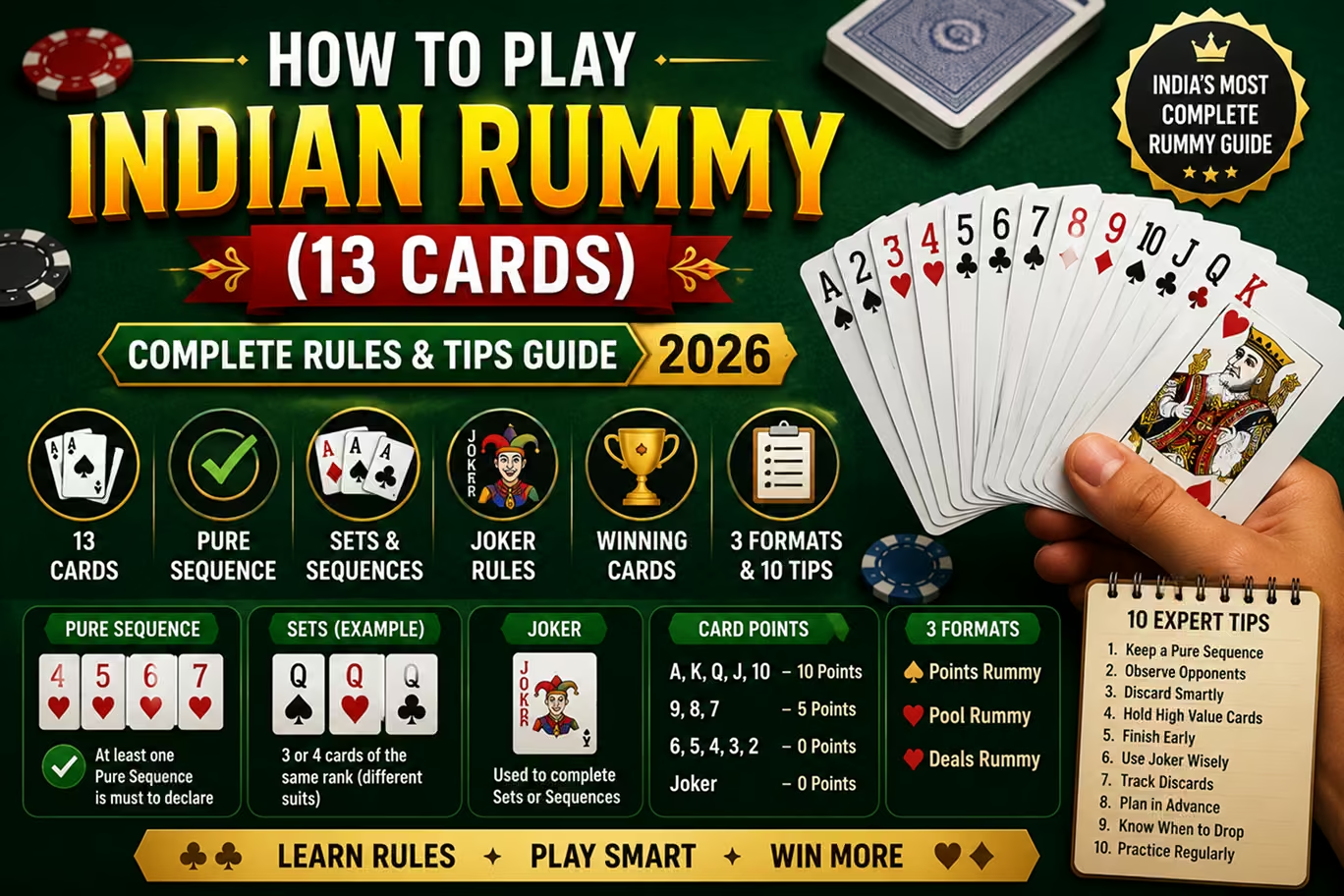
A Pure Sequence consists of 3 or more consecutive cards of the same suit with no Joker substituting any card. Every valid declaration must include at least one Pure Sequence — it is non-negotiable.
| Example | Suits Match? | Joker Used? | Valid Pure Sequence? |
| 5♥ 6♥ 7♥ | Yes — all Hearts | No | ✓ Valid |
| A♠ 2♠ 3♠ | Yes — all Spades | No | ✓ Valid |
| Q♣ K♣ A♣ | Yes — all Clubs | No | ✓ Valid |
| 9♦ 10♦ J♦ Q♦ | Yes — all Diamonds | No | ✓ Valid (4 cards) |
| 5♥ 6♥ Joker | Yes — but Joker used | Yes | ✗ NOT Pure — this is Impure |
4b. Impure Sequence
An Impure Sequence consists of 3 or more consecutive cards of the same suit where one or more cards are replaced by Jokers (Wild or Printed). Impure sequences count toward your declaration but cannot replace the mandatory Pure Sequence.
| Example | Joker Role | Valid? |
| 8♠ 9♠ [Wild Joker] | Joker substitutes for 10♠ | ✓ Valid Impure Sequence |
| [Printed Joker] 4♦ 5♦ | Joker substitutes for 3♦ | ✓ Valid Impure Sequence |
| 7♣ [Wild Joker] 9♣ | Joker substitutes for 8♣ | ✓ Valid Impure Sequence |
5. Valid Sets in Indian Rummy
A Set is a group of 3 or 4 cards of the same rank but from different suits. Sets are used to group remaining cards after your sequences are formed.
| Example | Same Rank? | Different Suits? | Valid Set? |
| 7♠ 7♥ 7♦ | Yes — all 7s | Yes | ✓ Valid Set |
| K♣ K♦ K♥ K♠ | Yes — all Kings | Yes (all 4 suits) | ✓ Valid Set (4-card) |
| [Joker] J♦ J♠ | Joker substitutes for J♥ or J♣ | Yes | ✓ Valid Set with Joker |
| 8♠ 8♠ 8♦ | Same rank but duplicate suit | No — two Spades | ✗ Invalid (in single deck game) |
6. Joker Rules — Wild Joker & Printed Joker
Jokers are the most powerful cards in Indian Rummy. Understanding how they work — and when to use them — is essential to winning consistently.
| Joker Type | What It Is | How It Works | Limitations |
| Printed Joker | The joker card printed in the deck | Substitutes for any card in an Impure Sequence or Set | Cannot be used to complete a Pure Sequence |
| Wild Joker | Randomly selected rank at start of round | All cards of that rank across all suits become Wild Jokers | Cannot be used in Pure Sequence; its natural value is lost when used as Joker |
| Wild Joker in natural position | Using Wild Joker as its actual card (e.g., 7♣ as 7♣ in a Sequence) | Counts as its natural card — valid in Pure Sequence | Can only count as natural card OR as Joker, not both simultaneously |
Joker Strategy
- Priority 1: Secure your Pure Sequence first — without Jokers.
- Priority 2: Use Jokers to complete Impure Sequences of high-value cards (J, Q, K, A) to reduce penalty points.
- Priority 3: If you have a Wild Joker of the right rank, consider using it in its natural position to form a Pure Sequence.
- Never: Waste a Joker on a low-value set when it could complete a high-value sequence.
7. Card Point Values in Indian Rummy
In Indian Rummy, every card has a point value. Points are bad — they represent the penalty load of ungrouped cards if an opponent declares before you. The goal is to reduce your unmatched point total to zero (valid declaration) or as close to zero as possible.
| Card | Point Value | Notes |
| Ace (A) | 10 points | High-value card — discard early if not in a sequence |
| King (K) | 10 points | High-value — discard early if not forming a sequence |
| Queen (Q) | 10 points | High-value — discard early if not forming a sequence |
| Jack (J) | 10 points | High-value — discard early if not forming a sequence |
| 10 | 10 points | Same value as face cards |
| 2 through 9 | Face value (2–9 pts) | 2 = 2 pts, 3 = 3 pts, etc. |
| Printed Joker | 0 points | No penalty if left ungrouped at declaration |
| Wild Joker (used as Joker) | 0 points | No penalty when acting as a substitute |
8. What Are the Rummy Winning Cards?
'Rummy winning cards' refers to the complete valid hand that qualifies for a winning declaration. To win, your 13 cards must be arranged as follows:
Example of a Valid Winning Hand (13 Cards)
| Group | Cards | Type | Valid? |
| Group 1 (MANDATORY) | 5♥ 6♥ 7♥ | Pure Sequence | ✓ Yes — no Joker |
| Group 2 | 9♠ 10♠ [Wild Joker] | Impure Sequence | ✓ Yes — Joker for J♠ |
| Group 3 | K♣ K♦ K♥ | Set | ✓ Yes — same rank, different suits |
| Group 4 | 3♦ 4♦ 5♦ 6♦ | Pure Sequence | ✓ Yes — bonus 4-card sequence |
Total: 3 + 3 + 3 + 4 = 13 cards. Has a Pure Sequence (Group 1). All cards in valid groups. This is a valid winning declaration.
Example of an INVALID Hand — Common Mistakes
| Mistake | Why Invalid | Penalty |
| No Pure Sequence — two Impure Sequences only | Pure Sequence is mandatory — Jokers cannot substitute in it | Wrong declaration penalty (typically 80 pts) |
| Only 12 cards accounted for — 1 card unmatched | All 13 cards must be in valid groups | Wrong declaration penalty |
| Set with two cards of same suit (single deck game) | Duplicate suit in single-deck game is invalid | Wrong declaration penalty |
| Sequence with 2 cards only | Minimum 3 cards needed in any group | Wrong declaration penalty |
9. How Scoring Works — Points, Penalty & Wrong Declaration
Winner's Score
The winner of a round scores 0 points. All losing players count the points of their ungrouped (unmatched) cards and add them to their running total (in Pool Rummy) or pay the winner accordingly (in Points Rummy).
Related Page:- Teen Patti Master vs Rummy
Loser's Penalty Calculation
Each losing player counts the points of all cards NOT in valid sequences or sets at the time of the winner's declaration. Cards already arranged in valid groups carry 0 penalty points.
| Situation | Penalty Points |
| Valid declaration (winner) | 0 points |
| Arranged some valid groups but not all 13 cards | Points of ungrouped cards only |
| No valid groups at all | Sum of all 13 cards (capped at 80 on most platforms) |
| Wrong declaration (invalid hand) | 80 points (full penalty, regardless of hand) |
| First drop (leaving before drawing first card) | 10 points (on most platforms) |
| Middle drop (leaving after first turn) | 30 points (on most platforms) |
| Printed Joker / Wild Joker (ungrouped) | 0 points |
10. Indian Rummy Formats — Points, Deals & Pool
Indian Rummy is played in three main formats. Each changes the stakes, speed, and strategy of the game:
| Format | How It Works | Best For | Typical Duration |
| Points Rummy | Single-round game. Winner earns cash = (sum of losers' points) × point value. Fastest format. | Quick sessions, testing strategy | 5–10 minutes per round |
| Deals Rummy | Fixed number of deals (typically 2 or 3). Players start with equal chips. Player with most chips at end wins. | Medium sessions, consistent play | 20–40 minutes |
| Pool Rummy (101/201) | Players contribute to a fixed pool. Players eliminated when they reach 101 or 201 cumulative points. Last player wins pool. | Long sessions, survival strategy | 30–90 minutes |
Points Rummy — Detailed Rules
Points Rummy is the most common format on online apps. Each point has a pre-agreed rupee value (e.g., ₹1 per point). If you win a round and opponents have 45, 30, and 25 points respectively, you earn (45+30+25) × ₹1 = ₹100.
Pool Rummy — Survival Strategy
In 101 Pool, any player reaching 101 cumulative penalty points is eliminated. The last player standing wins the entire pool entry fee. Mid-game drops become critical decisions — a 30-point mid-drop may be better than staying in a round you're likely to lose for 50+ points.
Related Page:- Hello Rummy
11. Ten Expert Winning Tips for Indian Rummy
Tip 1 — Build Your Pure Sequence First, Everything Else Second
This is the single most important rule in Rummy strategy. Until you have a Pure Sequence, you cannot declare — regardless of how well-arranged the rest of your hand is. The moment your cards are dealt, identify your best Pure Sequence candidate and work toward it before anything else.
Tip 2 — Discard High-Value Cards Early
Kings, Queens, Jacks, Aces, and 10s each carry 10 penalty points. If they don't fit neatly into a forming sequence or set within 2–3 turns, discard them. The risk of holding them while an opponent is close to declaring far outweighs the potential reward of completing a set with them later.
Tip 3 — Watch the Discard Pile Strategically
Every card your opponents pick from the open pile tells you something. If a player picks 8♥ from the discard pile, they likely need 6♥-7♥-8♥ or 8♥-9♥-10♥. Stop discarding cards in those adjacent ranges — you're helping them complete their sequence.
Tip 4 — Use Jokers to Complete High-Value Sequences
When you have a Joker, use it to replace a high-value card (J, Q, K, A) in an Impure Sequence. This simultaneously completes a valid group and removes high-penalty cards from your ungrouped pile. Using a Joker to complete a low-value sequence (2-3-4 of the same suit) wastes its penalty-reduction power.
Tip 5 — Keep Your Middle Cards
Middle-value cards (5, 6, 7, 8) are the most versatile in Rummy. A 6 can connect with 4-5 or 7-8 in either direction. A 7 can be part of 5-6-7, 6-7-8, or 7-8-9. High cards and low cards have fewer sequence possibilities. Hold your middle cards longer than your extremes.
Tip 6 — Never Pick from the Open Pile Just Because the Card Is Useful
Only pick from the open pile if the card directly and immediately completes or nearly completes a specific sequence or set. Picking a card your opponent can see tells them exactly what you need — they will stop discarding adjacent cards and deny your sequence.
Tip 7 — Consider a Drop When Your Hand Is Very Weak
In Points and Pool Rummy, a first drop costs 10 points and a middle drop costs 30 points. If your 13 cards include no sequence potential and several high-value cards, a first drop (10 points) may be far better than playing to a likely 60–80 point loss. Knowing when to drop is a skill, not a surrender.
Tip 8 — Track Which Cards Are Dead (Already Discarded)
The open discard pile is a history of all discarded cards. If both 7♣ and 7♥ are already in the discard pile, completing a set of 7s becomes impossible (or very constrained in a 2-deck game). Track dead cards actively to avoid waiting for cards that will never arrive.
Tip 9 — Use the 'Almost Pure Sequence' Rule in Your Favour
If you have 5♦ and 7♦ but not 6♦, decide early: are you waiting for 6♦ specifically, or will you take a Wild Joker for that slot? If 6♦ appears in the discard pile, pick it immediately. If a Wild Joker arrives before 6♦, take the Joker and form an Impure Sequence — don't stubbornly wait for a specific card.
Tip 10 — Practice in Free or Low-Stakes Games Before Real Money
Before joining high-stakes real-money Rummy tables, spend time on free or practice tables. Apps like Hello Rummy and Rumble Rummy offer low-stakes tables where the consequences of strategic mistakes are minimal. Build your instincts for hand sorting, discard decisions, and drop timing in low-pressure environments first.
Related Page:- Rumble Rummy
FAQs
How many cards are dealt in Indian Rummy?
Each player receives 13 cards in Indian Rummy — which is why it is also called 13 Card Rummy or Rummy 13. This distinguishes it from other Rummy variants like Gin Rummy (10 cards) or Canasta (11 cards).
What is a Pure Sequence in Indian Rummy?
A Pure Sequence is a group of 3 or more consecutive cards of the same suit, with no Joker substituting any card. Examples: 4♥ 5♥ 6♥, A♠ 2♠ 3♠, or 9♣ 10♣ J♣ Q♣. At least one Pure Sequence is mandatory in every valid declaration.
Can I use two Jokers in one sequence?
Yes — you can use two Jokers in a single Impure Sequence, as long as the sequence still has at least one natural (non-Joker) card. For example: [Joker] 7♦ [Joker] is a valid Impure Sequence representing 6♦ 7♦ 8♦ with two Jokers.
What is the difference between a sequence and a set in Indian Rummy?
A Sequence is 3+ consecutive cards of the same suit (e.g., 5♠ 6♠ 7♠). A Set is 3–4 cards of the same rank from different suits (e.g., 9♥ 9♠ 9♣). Both are valid groupings, but only sequences can satisfy the mandatory Pure Sequence requirement — sets cannot.
What are the rummy winning cards?
The rummy winning cards are any 13-card arrangement that includes at least one Pure Sequence, at least one additional sequence or set, and groups all remaining cards into valid sequences or sets — with zero ungrouped cards. The specific cards matter less than the combination structure.
What happens if I make a wrong declaration?
A wrong declaration — declaring with an invalid hand (no Pure Sequence, ungrouped cards, or invalid sets) — results in an immediate 80-point penalty. The game continues among remaining players. Always double-check your Pure Sequence and every group before pressing Declare.
Is Indian Rummy legal in India?
Yes — the Supreme Court of India has ruled Rummy to be a game of skill, making it legal to play for stakes in most Indian states. However, states including Andhra Pradesh, Telangana, Assam, Nagaland, Odisha, and Tamil Nadu have specific restrictions on real-money card games. Check your state's current regulations before playing on real-money platforms.
What is the difference between Points Rummy, Deals Rummy, and Pool Rummy?
Points Rummy is single-round — fastest format, played for a fixed point value per point (e.g., ₹1 per point). Deals Rummy runs for a fixed number of deals; the player with the most chips at the end wins. Pool Rummy is a survival format — players are eliminated when their cumulative penalty points reach 101 or 201; the last player remaining wins the pool.
How do I get better at Indian Rummy quickly?
Focus on three skills first: (1) Always identify your Pure Sequence path in the first 2–3 turns. (2) Discard high-value cards (J, Q, K, A) that don't fit your sequences early. (3) Watch the discard pile to understand what cards opponents need, and stop feeding them. These three habits alone will significantly improve your win rate.