How to Play Bluff Card Game — Complete Rules, Strategies & Tips (2026)
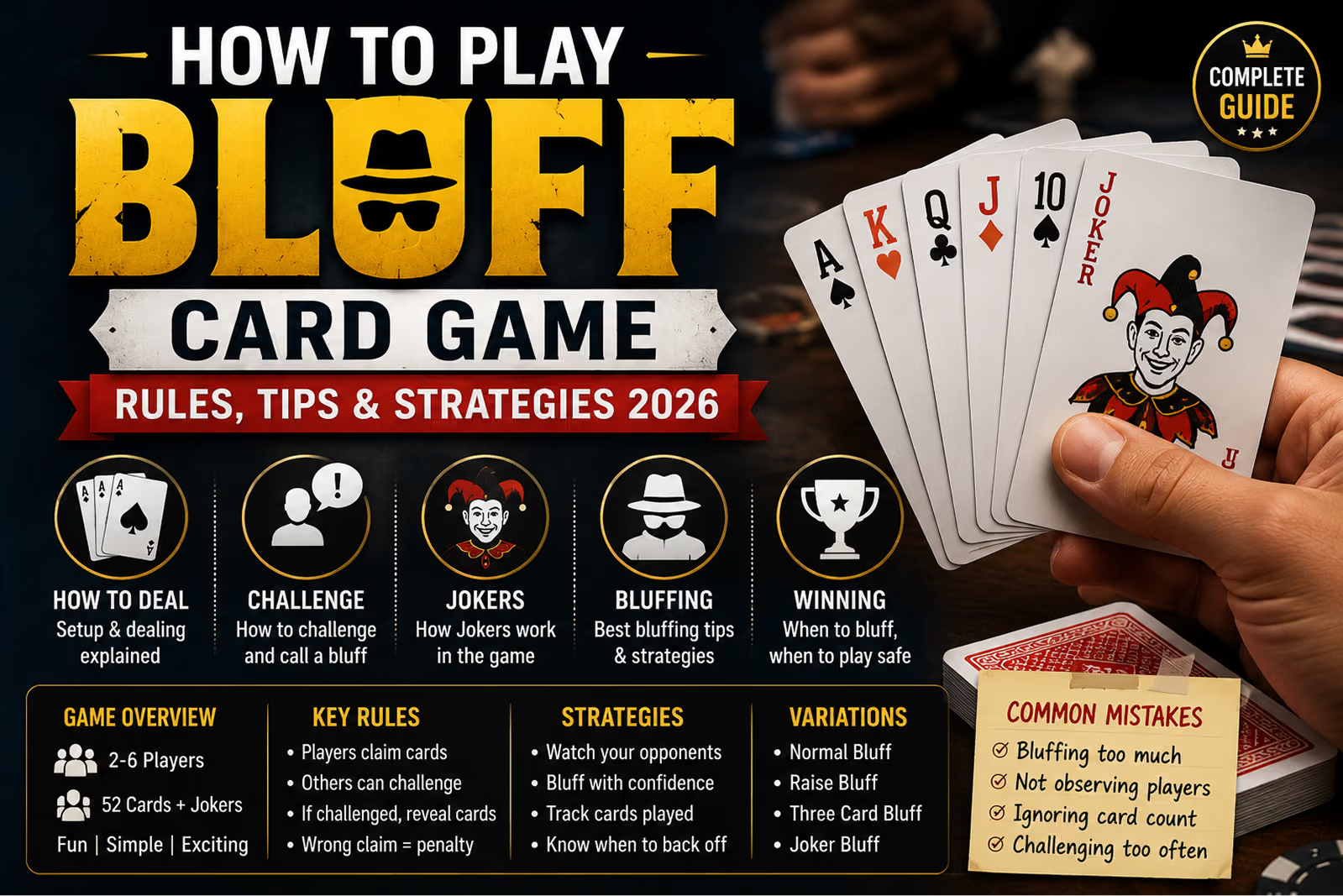
Bluff — also called Cheat, BS, I Doubt It, or 420 in India — is one of the most entertaining card games you can play anywhere, with anyone, using nothing but a standard deck of cards. The game rewards exactly two things: the ability to lie convincingly and the ability to spot when someone else is lying. No card-counting, no complex strategy — just pure psychological warfare around a table of cards.
Whether you're playing at a Diwali gathering, a college hostel, or a family game night, this complete guide covers every rule, every strategy, and every trick you need to play Bluff confidently and win more often.
What Is the Bluff Card Game?
Bluff is a card-shedding game where the objective is to get rid of all your cards before any other player. The twist: you can lie about the cards you play, as long as you don't get caught.
| At a Glance | Detail |
|---|---|
| Also Known As | Cheat, BS, I Doubt It, 420 (India), Show It, Cockroach |
| Players | 3 to 10 (ideal: 4–6) |
| Deck | 1 standard 52-card deck for 4 or fewer players; 2 decks for 5+ players |
| Jokers | Wild cards — always considered truthful (see Section 5) |
| Objective | Be the first to discard all your cards |
| Core mechanic | Play cards face down, declare their rank — truthfully or not |
| Duration | 20–45 minutes |
| Best for | All ages 8 and up; parties, family nights, hostel gatherings |
Related Article:- How to Play Teen Patti
What You Need to Play
- 1 standard 52-card deck + 2 printed Jokers for 4 or fewer players
- 2 standard 52-card decks + 4 printed Jokers for 5 to 10 players
- 3 to 10 players — no moderator needed, everyone plays
- A flat surface where all players can reach the centre discard pile
- 20 to 45 minutes
Bluff Card Game Rules — Step by Step
Here is the complete flow of one game of Bluff, from setup to winning:
Setup
- Shuffle the deck(s) thoroughly.
- Deal all cards one at a time, clockwise, to every player. It is fine if some players have one more card than others — this does not affect the game.
- Players hold their cards and keep them hidden from all other players.
- The player to the left of the dealer goes first.
How a Turn Works
On your turn, you must play one or more cards face down onto the central discard pile and declare their rank. The rank you declare must follow the sequence in play — in Indian Bluff (ascending order variant), you announce the next rank up from the previous player. In standard Bluff, you announce whatever rank you choose.
| Your Options on a Turn | What It Means |
|---|---|
| Play cards (truthfully) | Place the actual cards of the declared rank face down. You're telling the truth — but opponents don't know that. |
| Play cards (bluffing) | Place cards of a DIFFERENT rank face down, but declare the correct rank. You're lying — try not to get caught. |
| Pass (in variants that allow it) | Skip your turn — you don't play any card. You can still challenge other players on their turns. |
Related Article:- How to Play Indian Rummy
The Sequence of Play
- First player places 1 to 4 cards face down and announces: 'One Ace' or 'Two Threes' (declaring the rank, truthfully or not).
- Play continues clockwise. Each player must declare the same rank as the current round OR the next rank in sequence (depending on which variation you're playing — see Section 6).
- Any player (including those who have already played this round) may call 'Bluff!' or 'Challenge!' at any point after a player declares.
- When a challenge is called, the most recently played cards are revealed. The result determines who takes the pile (see Section 4).
- If no one challenges, the round continues. Cards accumulate in the discard pile.
- The first player to discard all their cards wins.
How Challenges Work — The Core Mechanic
Challenging is the heart of Bluff. When you say 'Bluff!' you're accusing the most recent player of lying about what they played. Here's exactly what happens:
| Challenge Outcome | What Happens |
|---|---|
| Challenge called — player WAS bluffing | The bluffer takes the ENTIRE discard pile into their hand. The challenger plays next. |
| Challenge called — player was TRUTHFUL | The challenger takes the ENTIRE discard pile into their hand. The truthful player plays next. |
| No challenge called | Play continues clockwise. The pile grows. |
| Multiple players challenge simultaneously | All challengers are treated as one challenge — if the player was truthful, all challengers pick up the pile jointly (or the first to speak picks it up, by agreement). |
Challenge Timing Rules
- You can challenge immediately after any player places cards and makes their declaration.
- Once the next player has started their turn (begun placing cards), the previous declaration is safe — you cannot challenge it retroactively.
- You can challenge even if you have already played your cards in the current round.
- Eliminated/finished players cannot challenge — once you've played your last card, you exit.
Related Article:- How to Play Mafia
Joker Rules in Bluff
Jokers have a special and powerful role in the Bluff card game. Their rules are consistent across most versions played in India:
| Joker Rule | Detail |
|---|---|
| Jokers are always truthful | A Joker played as any declared rank is NEVER considered a bluff — it passes automatically. |
| Can substitute for any rank | Play a Joker and declare it as 'Two Aces' or 'One Seven' — it counts as that rank without any risk of losing a challenge. |
| Cannot be challenged | If you suspect a Joker is in a played set, you can still challenge — but if a Joker is among the revealed cards, the player is considered truthful for those cards. |
| Joker does not count as a bluff | Even if a player plays a Joker alongside a bluffed card, the Joker portion is always valid. |
| End game with Joker | You can play a Joker as your last card — as long as you declare a valid rank, you win. |
Indian Bluff vs Standard Bluff — Key Differences
The version of Bluff most commonly played in India has some specific rules that differ from the international standard. Here's a clear comparison:
| Rule | Indian Bluff (420 / Cheat India) | Standard International Bluff |
|---|---|---|
| Rank sequence | Cards played in ascending order — Ace, 2, 3, 4... K, then back to Ace | Lead player announces any rank; others must also play that same rank |
| Number of cards per turn | 1 to 4 cards (maximum 4 of the same rank) | 1 to 4 cards (same) |
| Passing | Not always permitted — varies by group | Permitted — you can skip your turn |
| Joker rules | Wild card, always truthful | Wild card (same) — some groups exclude Jokers |
| Challenge language | 'Bluff!' or 'Show it!' | 'BS!', 'Cheat!', 'I Doubt It!' |
| Losing condition | Pick up entire pile | Pick up entire pile (same) |
| Named after | IPC Section 420 (fraud) — affectionate cultural reference | Called Cheat or BS in UK/US |
Quick-Reference Decision Table
Use this table to decide what to do on your turn:
| Your Situation | Best Action | Why |
|---|---|---|
| You have the required rank card(s) | Play them truthfully | No bluff risk — save deception energy for when you need it |
| You don't have the required rank but have Jokers | Play the Joker as that rank | Jokers are always truthful — zero challenge risk |
| You have no required rank, no Joker, many cards in hand | Bluff with a similar-looking card | Holding cards too long is dangerous — take the risk |
| You have no required rank, no Joker, only 1-2 cards left | Bluff carefully — you're close to winning | Being forced to pick up the pile at 1 card is painful |
| Pile is very large (20+ cards) | Challenge aggressively before playing | Big pile risk = high reward for catching a bluff |
| Pile is very small (3-5 cards) | Less urgency to challenge | Picking up 3 cards isn't catastrophic |
| Opponent always plays exactly 1 card for high ranks (J,Q,K,A) | Challenge — likely a bluff | Most players genuinely hold few high-rank cards |
| Opponent is playing very fast / not hesitating | More likely truthful | Bluffers often pause, even briefly |
Bluffing Strategies — How to Lie Convincingly
Strategy 1 — Maintain Consistent Speed
The biggest tell in Bluff is hesitation. Players who are lying often pause slightly before placing their cards — their brain is working harder than usual. Train yourself to place cards at the same speed whether you're being truthful or bluffing. Your physical rhythm should be identical in both cases.
Strategy 2 — Bluff with Confidence, Not Aggression
Overconfident bluffing — slamming cards down, making dramatic declarations — draws attention and suspicion. Equally, being too quiet when bluffing makes you seem nervous. The ideal bluff is calm, matter-of-fact: place the cards, say the rank, make eye contact naturally, and move on.
Strategy 3 — Bluff the Ranks No One Wants
In the ascending-order variant, certain ranks (2s, 3s, low cards) get played early when everyone still has plenty of cards. High ranks (Q, K, A) are played later when hands are thinner and challenges are more likely. Paradoxically, this is when truthful plays are also more common — making high-rank bluffs harder to detect because opponents expect you might be telling the truth.
Strategy 4 — Tell the Truth When You're Suspected
If you've bluffed successfully twice in a row, opponents will watch you closely on your next play. Strategically choose to play truthfully at this moment — when challenged, you win the challenge, your opponent picks up the pile, and you've rebuilt your credibility for the next bluff.
Strategy 5 — Use Multiple Cards to Hide the Bluff
Playing 'Three Fives' is harder to challenge than 'One Five.' The challenger knows that with 3 cards played, the probability of at least one being a genuine Five is higher. Playing multiple cards also depletes your hand faster — a double advantage.
Related Article:- How to Play Indian Rummy
When to Call a Bluff — Reading Your Opponents
High-Probability Challenge Situations
| Signal | What It Suggests | Challenge Confidence |
|---|---|---|
| Player declares 4 cards of the same rank | Only 4 of each rank exist in a single deck. If you hold even one of that rank, they cannot have 4 truthfully. | Very High — challenge immediately |
| Player has been truthful all game and suddenly plays fast | Change in rhythm can indicate a bluff — they're compensating for hesitation | High |
| Player plays a rank you hold all 4 of | You have all copies — their declaration must be a bluff | Certain — challenge always |
| Player always plays 1 card for Aces, Kings, Queens | Most players genuinely hold few of these. Repeated single-card high-rank plays suggest bluffing. | High |
| Player is close to winning (1–2 cards left) | Desperation bluffs increase dramatically near the end | High — especially valuable timing |
| Player laughs, looks away, or speaks differently after placing | Behavioural shift often accompanies deception | Medium — use with other signals |
| Pile is very large | Higher risk = greater reward for catching a bluff. More incentive to challenge. | Use pile size to amplify decision |
Low-Priority Challenge Situations
- Player plays 1–2 cards of a mid-rank (5, 6, 7, 8) — these are common and challenging wastes your credibility.
- Player has been catching bluffs themselves — they're playing carefully and likely being truthful.
- The pile is very small — even if you win the challenge, the reward isn't worth the strategic exposure.
Hand Management — Which Cards to Play First
How you organise and sequence your card plays has a significant impact on your chances of winning. Here are the key hand management principles:
Principle 1 — Identify Your 'Problem Ranks' Early
Sort your hand by rank immediately after being dealt. Identify which ranks you have zero or only one card of — these are your problem ranks. When the sequence reaches those ranks, you'll be forced to bluff. Mentally preparing for these moments is better than panicking when they arrive.
Principle 2 — Play High-Count Ranks When They're Called
If you have three 7s and 7 is the current rank, play all three truthfully. Getting rid of 3 cards in one turn is faster than 3 separate turns. High-count ranks played in full also eliminate the risk of being forced to bluff that rank in a future round.
Principle 3 — Hold 1–2 Cards in Strong Ranks as Bluff Cover
If you have four Jacks, consider playing two now and holding two for later. Having a Jack in your hand when the Jack round comes around gives you truthful-play options. More importantly, it makes challenging your Jack declaration very risky for opponents — they know at least one Jack exists in your hand.
Principle 4 — Never Discard a Joker Too Early
Jokers are your guaranteed-safe plays for any rank. Keep them for the rounds where your hand has nothing of the required rank and bluffing would be high-risk. Using a Joker in round 2 when you still have plenty of options is a waste of your strongest card.
Principle 5 — Watch the Pile Size and Adjust Aggression
When the pile is small, play more carefully — being caught picking up 5 cards is manageable. When the pile grows large, both your bluffing risk and your challenge opportunity increase. Adjust how boldly you bluff and how aggressively you challenge based on the current pile size.
Common Beginner Mistakes to Avoid
| Mistake | Why It Hurts | What to Do Instead |
|---|---|---|
| Challenging every play that seems suspicious | Failed challenges = picking up the pile repeatedly; you'll always have too many cards | Only challenge when 2+ clear signals point toward a bluff |
| Playing Jokers in the first few rounds | Wastes your safest card when you don't need it yet | Save Jokers for high-risk moments when you have nothing of the required rank |
| Bluffing with obvious hesitation | Your pause is your tell — experienced players will challenge immediately | Practice placing cards at the same speed every time, regardless of truth |
| Trying to play too many cards in one go when bluffing | More cards = more chance of inconsistency if challenged | When bluffing, play 1–2 cards maximum to minimise the exposed risk |
| Forgetting which ranks have already been played | You may declare a rank that's already been exhausted — opponents who counted will challenge | Track which ranks have completed full sets in the pile |
| Not reading opponent hand sizes | A player with 2 cards left will bluff desperately — high challenge opportunity | Watch hand sizes constantly, not just the declared rank |
| Celebrating too early | Smiling when you play truthfully is a tell — opponents learn to challenge when you don't smile | Keep facial expression constant regardless of what you've played |
Popular Variations of Bluff
| Variation | How It Differs | Best For |
|---|---|---|
| Standard Bluff (International) | Lead player announces any rank; all others must declare the same rank that round | First-time players — simplest version |
| Indian Bluff / 420 | Cards played in ascending order — A, 2, 3, 4... K, then back to A. Each player must declare the next rank. | Indian house parties, college games — most common variant in India |
| Two-Deck Bluff | Played with 2 decks — more cards per rank (up to 8 of each), larger groups | 5–10 players — keeps the game balanced |
| No-Pass Bluff | Players cannot pass — must play a card every turn | Faster, more intense game — forces more bluffs |
| Multiple-Rank Bluff | Players can declare any rank (not just the current one) — complete freedom | Experienced players, creates maximum chaos |
| Canadian Bluff | Two decks, players can also declare one rank above or below the announced rank | Larger groups wanting more flexibility |
| Penalty Bluff | Caught bluffer draws extra cards from the deck (not just the pile) as additional penalty | Adds extra punishment for getting caught — shorter games |
FAQs
What is the Bluff card game called in India?
In India, Bluff is most commonly called 420 (a reference to IPC Section 420, the fraud section of the Indian Penal Code — used affectionately to describe the game's deceptive nature). It is also called Cheat, Show It, or simply Bluff. The international versions are called BS (British Slang), Cheat, or I Doubt It.
How many players can play Bluff?
Bluff works with 3 to 10 players. The ideal range is 4 to 6 players — enough people for meaningful deception and observation without making individual turns too infrequent. With more than 6 players, use two decks to ensure enough cards.
Can you play Bluff with 2 players?
Technically yes, but it is not recommended — with only 2 players, there is very little deception possible since each player knows exactly what the other has declared. Bluff requires at least 3 players to generate meaningful uncertainty and strategy.
What happens when the deck runs out in Bluff?
The deck is fully dealt at the start of the game — there is no draw pile. All cards are in players' hands. The only time cards move is when the discard pile is picked up after a challenge. The game ends when one player runs out of hand cards.
Can you play more than 4 cards in one turn in Bluff?
No — the maximum is 4 cards per turn, since only 4 of each rank exist in a standard deck (or 8 in a two-deck game). Playing more than 4 and declaring them as one rank is automatically a bluff since it's mathematically impossible for all to be genuine.
What is the Joker rule in Bluff?
Jokers are wild cards that are always considered truthful. A player can declare a Joker as any rank and cannot be successfully challenged on that card — even if everything else in their play is a bluff. The Joker portion always passes. Jokers are typically not removed from the deck in the Indian version.
Is Bluff a game of luck or skill?
Bluff has a small luck element in the initial deal — some hands are easier than others. But the game is primarily skill-based, involving psychological reading, strategic bluffing, challenge timing, hand management, and memory (tracking which cards have been played). The same players tend to win consistently in long sessions.
How do you win at Bluff quickly?
The fastest path to winning: (1) Get rid of ranks you have many cards of as quickly as possible by playing truthfully. (2) Use Jokers for problem ranks rather than bluffing on them. (3) Challenge selectively — only when confident. (4) Bluff with 2 cards at a time to reduce exposure. (5) Never hesitate when placing cards, truthful or not.