How to Play Call Break (Callbreak) — Complete Rules, Bidding, Scoring & Strategies (2026)
Call Break, also called Callbreak, Lakdi, Call Bridge, or Judgement in India is one of the most strategic card games popular across India, Nepal, and South Asia. Unlike pure luck-based games, Call Break rewards careful hand assessment, accurate bidding, smart trump management, and trick-by-trick planning. If you've watched others play and wondered what 'calls' and 'tricks' mean, this complete guide explains everything.
What Is Call Break?
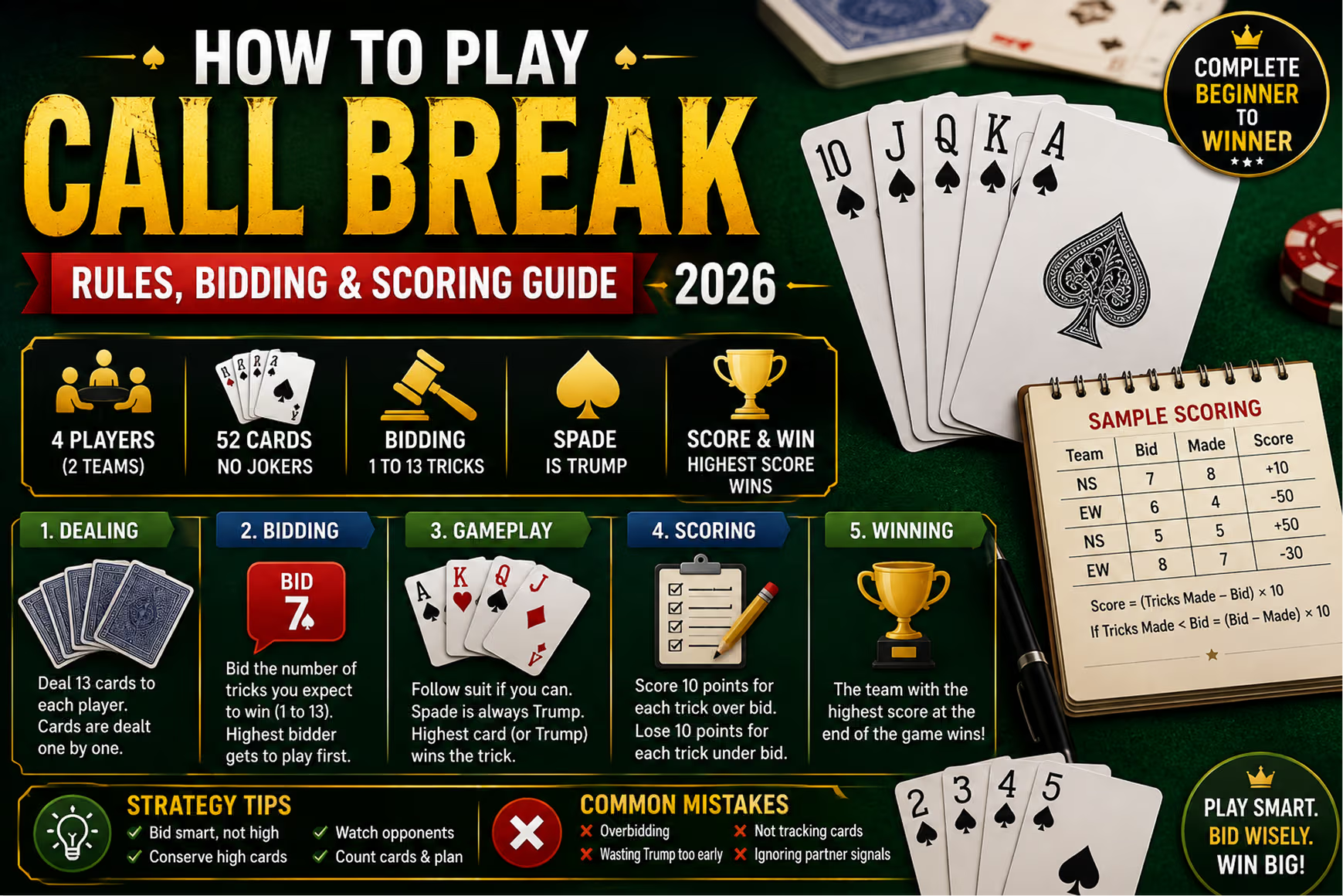
Call Break is a four-player trick-taking card game where each player independently bids how many tricks they expect to win in a round — and then must deliver exactly that many (or more). Spades are always the trump suit, meaning any Spade card beats any card of any other suit.
| At a Glance | Detail |
|---|---|
| Also Known As | Callbreak, Lakdi, Call Bridge, Judgement, Ghochi (regional names) |
| Players | Exactly 4 (always — no more, no less) |
| Deck | Standard 52-card deck, no Jokers |
| Cards per Player | 13 cards each |
| Trump Suit | Spades (♠) — always, every round, no exception |
| Rounds | Typically 5 rounds (can vary by agreement: 3, 4, or 8) |
| Objective | Accurately bid and win your declared number of tricks; accumulate the highest score |
| Popular in | India, Nepal, Bangladesh, Bhutan, Sri Lanka |
| Skill or Luck | Primarily skill — bidding, trick-tracking, and trump management decide outcomes |
What You Need to Play
- 1 standard 52-card deck — no Jokers used
- Exactly 4 players — Call Break is specifically designed for 4
- Paper and pen for scorekeeping, or a scorekeeper app
- An agreed number of rounds (5 is standard)
Card Rankings in Call Break
Cards rank the same way across all suits, but Spades (♠) always outrank all other suits regardless of rank:
| Within Any Suit | Ranking (High to Low) | Special Rule |
|---|---|---|
| All Spades (♠) | A♠ > K♠ > Q♠ > J♠ > 10♠ > 9♠ > 8♠ > 7♠ > 6♠ > 5♠ > 4♠ > 3♠ > 2♠ | Any Spade beats ANY card of any other suit — even a 2♠ beats an A♥ |
| Hearts (♥) | A♥ > K♥ > Q♥ > J♥ > 10♥ > 9♥ > 8♥ > 7♥ > 6♥ > 5♥ > 4♥ > 3♥ > 2♥ | Highest of the lead suit wins — unless a Spade is played |
| Diamonds (♦) | A♦ > K♦ > Q♦ > J♦ > 10♦ > 9♦ > 8♦ > 7♦ > 6♦ > 5♦ > 4♦ > 3♦ > 2♦ | Same as Hearts — lead suit unless beaten by Spade |
| Clubs (♣) | A♣ > K♣ > Q♣ > J♣ > 10♣ > 9♣ > 8♣ > 7♣ > 6♣ > 5♣ > 4♣ > 3♣ > 2♣ | Same as Hearts and Diamonds |
Call Break Rules — Step by Step
Setup
14. Determine the first dealer by having each player draw a card from the shuffled deck — the player with the lowest card deals first. In subsequent rounds, the dealer rotates clockwise.
15. The dealer shuffles the full 52-card deck and deals all 13 cards to each player, one at a time, going clockwise (or counter-clockwise in Nepal/some Indian regions).
16. Players pick up and sort their hand. Do not show cards to other players.
Bidding Phase
17. Starting from the player to the dealer's left (or right in some regions), each player declares their 'call' — the number of tricks they expect to win this round.
18. Minimum call is 1. Maximum call is 13 (all tricks).
19. Each player calls only once. There is no re-bidding.
20. The dealer records all four calls. These numbers are the targets each player must meet.
21. Rule in some regions: If the total of all four calls is less than 8, the cards are redealt.
Playing Tricks
22. The player to the right of the dealer leads the first trick by playing any card of their choice.
23. Each subsequent player must follow suit — play a card of the same suit as the lead card if they have one.
24. If a player has no card of the lead suit, they may play any Spade (trump) or any other card.
25. The trick is won by: the highest Spade played (if any Spade was played), OR the highest card of the lead suit (if no Spade was played).
26. The winner of each trick leads the next trick.
27. Continue until all 13 tricks in the round have been played.
End of Round
28. Count each player's tricks won and compare to their call.
29. Apply scoring rules (see Section 7).
30. Rotate the dealer and begin the next round.
31. After all rounds are complete, the player with the highest total score wins.
How Bidding (Calling) Works
Your bid (called your 'call') is a commitment — declare the number of tricks you will win, then deliver that number. The bid system is what separates Call Break from pure luck games.
| Bid Type | When to Use It | Risk Level |
|---|---|---|
| Conservative bid (1–3) | Weak hand, few high cards, few Spades | Low risk — easy to meet, but low score potential |
| Moderate bid (4–6) | Mixed hand — some high cards and 1–2 Spades | Balanced — most common bids in experienced play |
| Aggressive bid (7–9) | Strong hand — multiple Aces/Kings + 3+ Spades | High risk, high reward — only if hand clearly supports it |
| Maximum bid (10–13) | Exceptional hand — almost all high cards | Very rare — only justifiable with 5+ Spades and 3+ Aces |
| Nil bid (0) | Not standard — some variation allow zero bids | Wins large bonus if no tricks taken; severe penalty if failed |
Dealer Advantage
The dealer bids last, which gives them a strategic advantage: they can see all other players' calls and adjust their own bid accordingly. For example, if the first three players bid 3, 4, and 5 (total 12), the dealer knows they must win at least 1 trick to avoid the cards being redealt (total must be 8+). The dealer can also exploit overbidding by others — if others are likely to fail their calls, winning even modest tricks scores well.
How Tricks Are Won — The Core Mechanic
Each trick consists of one card played by each of the four players. Here is exactly how winner determination works:
| Scenario | Who Wins the Trick? | Example |
|---|---|---|
| No Spades played | Highest card of the lead suit wins | Lead: 9♥. Plays: K♥, 3♥, J♦. Winner: K♥ (highest Heart played) |
| One Spade played | The Spade wins (regardless of rank) | Lead: A♥. Plays: K♥, 2♠, J♦. Winner: 2♠ (any Spade beats any other suit) |
| Multiple Spades played | Highest Spade wins | Lead: 8♣. Plays: A♣, 4♠, K♠. Winner: K♠ (highest Spade) |
| Everyone plays Spades | Highest Spade wins | Lead: 5♠. All play Spades. Highest Spade among the four wins. |
| Off-suit with no Spade | Highest card of lead suit wins | Lead: 7♦. Plays: 2♦, Q♣, 9♦. Winner: 9♦ (highest Diamond; Q♣ is off-suit and irrelevant) |
Call Break Scoring — With Worked Example
Call Break scoring rewards accurate bidding and penalises under-delivery. Here are the standard scoring rules:
| Outcome | Score | Detail |
|---|---|---|
| Met exact call | Call amount (positive) | Called 5, won exactly 5 → +5 points |
| Won more than called (overtricks) | Call + 0.1 per extra trick | Called 5, won 7 → +5.2 points (2 extra tricks = +0.2) |
| Won fewer than called (failed bid) | Negative of call amount | Called 5, won 3 → -5 points |
| Won 0 tricks on a non-zero call | Negative of call amount | Called 3, won 0 → -3 points |
| Won 0 tricks on a 0 call (Nil — if allowed) | Special bonus (typically +10) | Only if Nil bids are permitted in your variation |
Worked Scoring Example — One Full Round
| Player | Call | Tricks Won | Score This Round | Reason |
|---|---|---|---|---|
| Player A | 4 | 4 | +4.0 | Met exact call |
| Player B | 3 | 5 | +3.2 | Called 3, won 5 — +2 extra = +0.2 bonus |
| Player C | 5 | 3 | -5.0 | Failed bid — called 5, won only 3 |
| Player D | 2 | 2 | +2.0 | Met exact call — conservative and successful |
| Total | 14 (all 13 tricks + 1 check) | Note: Total tricks across all players always = 13 |
Hand Assessment Framework — What to Bid
Before bidding, assess your hand using this framework — count your likely tricks from each source:
| Card Type | Likely Tricks | Assessment Method |
|---|---|---|
| Ace of any non-Spade suit | 0.8–1 trick likely | Will win unless opponent voids the suit and plays Spade |
| King of any non-Spade suit (with Ace also present) | 0.6–0.8 tricks likely | Depends on whether Ace appears before your King |
| King of non-Spade suit (without Ace in hand) | 0.4–0.5 tricks | Riskier — another player's Ace may block it |
| Ace of Spades (A♠) | 1 trick certain | Always wins — highest card in the game |
| King of Spades (K♠) | 0.9 tricks likely | Wins unless opponent has A♠ and plays it here |
| High Spades (Q♠, J♠, 10♠) | 0.5–0.7 tricks each | Valuable but can be beaten by higher Spades |
| Low Spades (2♠–9♠) | 0.3–0.5 tricks | Useful as trump to capture lead-suit tricks |
| Void in a suit (no cards of that suit) | 0.5–1 extra trick | Each void lets you trump any trick led in that suit |
Bid Calculation Example
Hand: A♠, 7♠, 3♠, A♥, K♥, Q♦, 7♦, 5♦, 2♦, 8♣, 6♣, 4♣, 3♣
- A♠ → 1 certain trick
- 7♠, 3♠ → 0.5 + 0.3 = ~0.8 tricks (2 additional Spades)
- A♥ → ~0.9 tricks (might be trumped if someone is void in Hearts)
- K♥ → ~0.5 tricks (depends on A♥ being played first)
- Q♦, 7♦, 5♦, 2♦ → 0.2 tricks total (low Diamond cards, easily beaten)
- Void in no suit — hand has all 4 suits represented
Total estimate: 1 + 0.8 + 0.9 + 0.5 + 0.2 = ~3.4 tricks → Bid 3 (conservative) or 4 (moderate)
Eight Winning Strategies
Strategy 1 — Bid Conservatively Until You Know the Players
In your first several rounds with a group, bid 1–2 tricks below your estimated maximum. This ensures you meet your call while you learn how aggressively others bid and how freely they play Spades. Under-bidding costs only the overtime bonus — over-bidding costs your full call.
Strategy 2 — Lead With High Non-Spade Cards Early
In your first few tricks, lead with your highest non-Spade cards (Aces, Kings of Hearts, Diamonds, Clubs). This forces opponents to either follow suit or trump early. If they follow suit, you win the trick. If they trump, you learn which opponents are void in which suits — valuable information for later tricks.
Strategy 3 — Track Which Suits Have Been Played
After each trick, mentally note which suits have been played and which opponents played off-suit (indicating they are void in that suit). A player who played a Spade when Hearts were led is void in Hearts — don't lead Hearts to them expecting to win. Track these voids carefully across all 13 tricks.
Strategy 4 — Save High Spades for Critical Tricks
Your high Spades (A♠, K♠, Q♠) are your most powerful cards. Don't waste them on tricks you'd win anyway with a non-Spade Ace. Save them for tricks where you must win to meet your call, or to prevent an opponent from winning a trick that would push them over their call.
Strategy 5 — Use Low Spades to Disrupt, Not Win
Low Spades (2♠–6♠) are unlikely to win tricks against other players with Spades. Use them tactically — play a low Spade to steal a trick from a non-Spade leader when you need one more trick to meet your call, but don't waste a high Spade on the same play.
Strategy 6 — Watch Others' Call Progress
Keep track of how many tricks each player has won versus their call. If Player B called 4 and has already won 4, they have no incentive to fight for the next trick. If Player C called 5 and has won only 2 with 4 tricks remaining, they are desperate — expect them to play Spades aggressively. Adjust your strategy based on others' progress.
Strategy 7 — Exploit Void Suits to Create Tricks
If you are void in a suit (no cards of that suit), you can trump any trick led in that suit. Plan ahead — identify your void suits before bidding and factor in the extra tricks they'll generate. A player void in two suits has significant trump leverage.
Strategy 8 — In Final Tricks, Focus on Your Target
In the last 3–4 tricks of a round, stop thinking about winning tricks overall and focus exclusively on whether you're on track to meet your call. If you've already met your bid, consider deliberately losing low-stakes tricks to avoid over-winning, which only gives fractional score bonuses while burning good cards.
Trump (Spade) Management
Spade management is the most skill-intensive aspect of Call Break. Here's how to think about your Spades:
| Situation | Recommended Spade Play | Reason |
|---|---|---|
| You're winning comfortably and have met your call | Hold high Spades, play low Spades only if needed | Save A♠/K♠ for later emergencies |
| You're one trick short of your call with 2 tricks left | Play your highest Spade to guarantee the trick | Reliability > conservation at this point |
| Opponent is one trick short of their call | Play a high Spade to block their critical trick | Preventing their success can affect the standings |
| You're void in the lead suit and have many Spades | Use the lowest Spade that will win | Preserve higher Spades for more important tricks |
| Last trick of the round, you need it to meet call | Play A♠ or K♠ — don't gamble | Certainty is more valuable than conservation at endgame |
| First trick of the round | Avoid playing Spades unless you have only Spades | Preserve trump advantage; gather information first |
Common Beginner Mistakes to Avoid
| Mistake | Why It Hurts | What to Do Instead |
|---|---|---|
| Overbidding based on total card count | Having 13 cards doesn't mean winning 13 tricks — only high cards and Spades generate tricks | Assess by card quality, not quantity |
| Playing high Spades in early tricks | Wastes your most powerful cards on tricks you might have won anyway | Lead non-Spade Aces first; save Spades |
| Forgetting to follow suit | Reneging (having a suit card but playing another) is a rule violation | Always check your hand for the lead suit before playing |
| Ignoring others' call progress | Missing that an opponent needs exactly 1 more trick means you don't block them when you should | Track all four players' trick counts constantly |
| Playing off-suit expecting to win | An off-suit card (non-Spade, non-lead suit) can never win a trick | Only Spades and the lead suit can win |
| Bidding 1 every round to 'stay safe' | Consistently undershooting caps your score — others build large leads | Bid accurately; overly conservative bidding loses matches |
| Not counting opponent Spades | Not knowing how many Spades have been played makes late-game trump decisions blind | Actively count Spades played from the start of each round |
Popular Call Break Variations
| Variation | How It Differs | Where Common |
|---|---|---|
| Standard Call Break (5 rounds) | 5 rounds, Spades always trump, individual scoring | Most of India, Nepal — default online version |
| Counter-clockwise (Nepali style) | Cards dealt and tricks played counter-clockwise instead of clockwise | Nepal, some parts of North India |
| 3-round Call Break | Faster format — only 3 rounds total | Quick games, time-limited sessions |
| 8-round Call Break | Extended format — 8 rounds for longer sessions | Serious competitive play |
| Nil bid allowed | Players may bid 0 tricks — bonus if successful, large penalty if they win even one trick | Some online app versions |
| Partnership Call Break | 2 vs 2 teams — team's combined tricks vs combined calls | Social gatherings, team competitions |
| Point-based scoring | Each trick worth a fixed point value instead of call-based scoring | Simplified version for beginners |
FAQs
How many players can play Call Break?
Call Break is designed specifically for exactly 4 players. Unlike most card games, it cannot be played with 3 or 5 players because the 52-card deck divides perfectly into 13 cards for each of 4 players — a fundamental structural requirement of the game.
Why are Spades always the trump in Call Break?
Call Break is derived from the American game Spades, where Spades are also always trump. The fixed trump suit (rather than a randomly selected one) is what defines Call Break's strategic character — players know from the moment they see their hand which suit dominates, and can plan accordingly.
What happens if I win fewer tricks than my call?
You receive a negative score equal to your call amount. If you called 5 and won only 3 tricks, your score for that round is -5. This negative carries into your running total, which can put you significantly behind. Accurate bidding is therefore essential — it is better to bid 3 and win 4 (score: +3.1) than to bid 5 and win 4 (score: -5).
Can I play a Spade at any time?
No — you must follow the lead suit if you have a card of that suit. You may only play a Spade if you have no cards of the lead suit. Playing a Spade when you have the lead suit is called reneging and is against the rules.
What does 'void in a suit' mean in Call Break?
Void means you have no cards of a particular suit. Being void in Hearts, for example, means you can play any Spade (or any other card) whenever Hearts are led — since you have no Hearts to follow suit with. Being void in multiple suits gives you significant freedom to play Spades strategically.
How many rounds are played in Call Break?
The standard game is 5 rounds. Some groups play 3 rounds for a faster game or 8 rounds for extended play. The number of rounds should be agreed before the first deal.
What is the minimum bid in Call Break?
The minimum bid is 1 — every player must call at least 1 trick. In some regional versions, the cards are redealt if the total of all four calls is less than 8 (ensuring a minimum of 2 per player on average).
Is Call Break the same as Spades?
Call Break is derived from Spades and shares the core mechanic — Spades always trump, players bid tricks, must follow suit. The main differences: Call Break is always 4-player individual (Spades is often 4-player partnership), scoring uses decimal bonuses for overtricks differently, and Call Break is played in a fixed number of rounds rather than to a target score.
What is a good score in Call Break?
A final score above 20 across 5 rounds is generally considered strong. A score above 25 indicates near-perfect bidding accuracy throughout. Negative final scores are possible if a player consistently overbids and fails their calls.