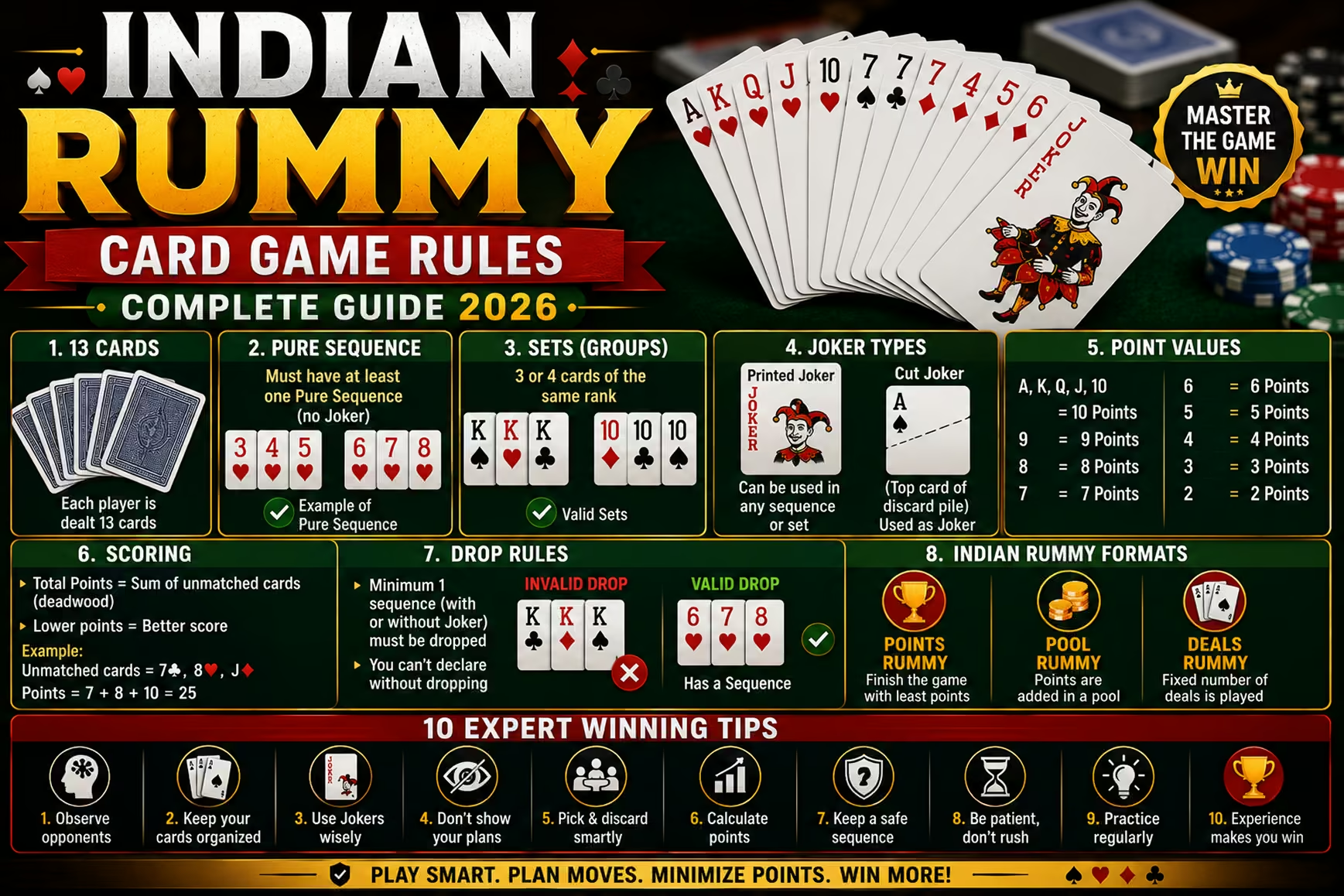
Indian Rummy Card Game Rules — Complete 13-Card Guide with Sequences, Sets, Jokers & Scoring (2026)
Indian Rummy - also called Paplu, 13 Card Rummy, or simply Rummy - is one of India's most-played skill card games. From Mumbai local train compartments to Diwali family gatherings to real-money online platforms with millions of daily players, the same 13-card ruleset drives every game. Whether you're a complete beginner or looking to sharpen your understanding of sequences, Joker rules, and scoring, this is the most complete guide to Indian Rummy card game rules available.
What Is Indian Rummy?
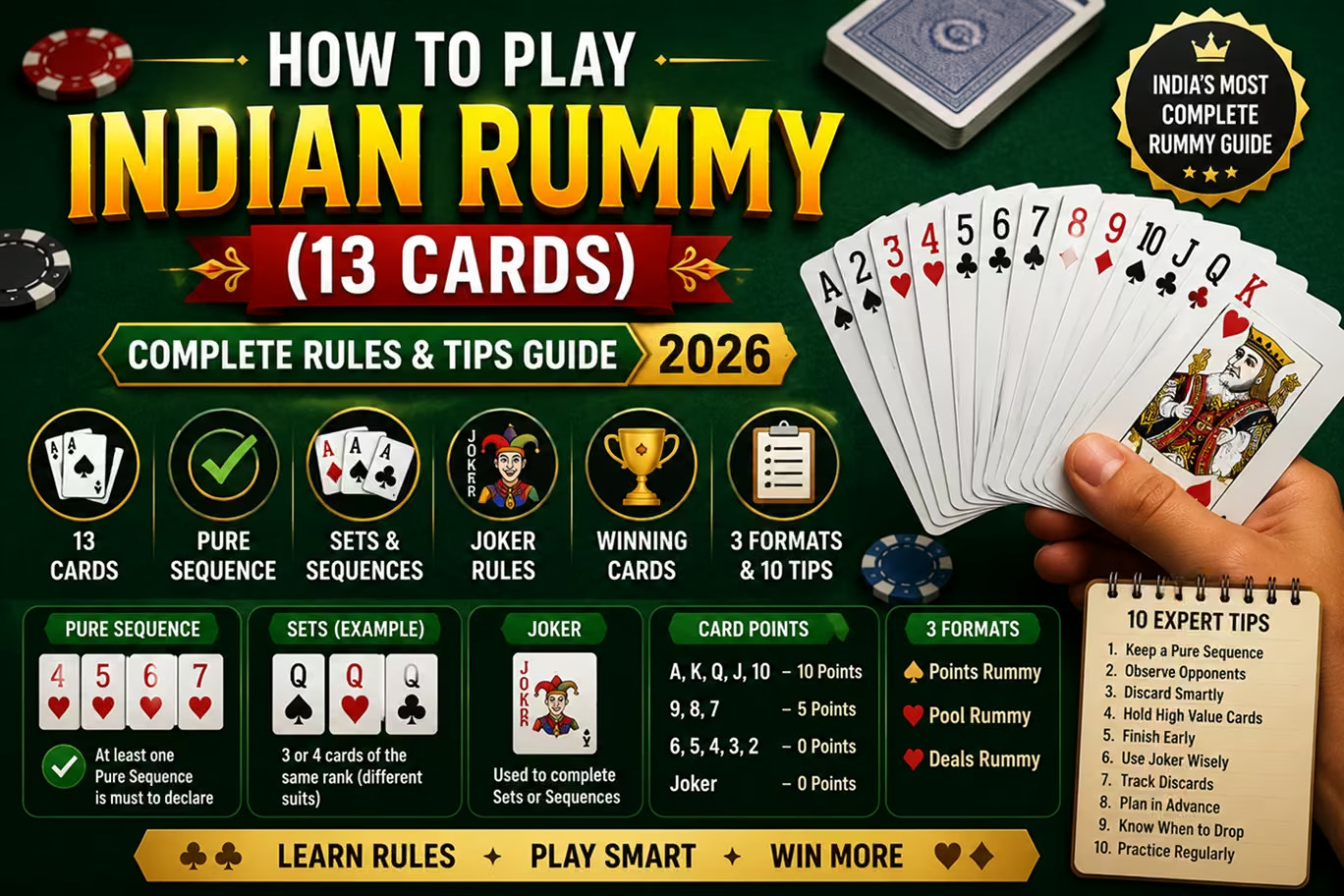
Indian Rummy is a draw-and-discard card game where each player receives 13 cards and must arrange them into valid combinations — called sequences and sets — before declaring. The first player to form a valid, complete hand and declare wins the round.
| At a Glance | Detail |
|---|---|
| Also Known As | Paplu, 13 Card Rummy, Rummy 13, Indian Rummy Online |
| Players | 2 to 6 players |
| Decks | 2 standard 52-card decks + 4 printed Jokers (for 2–6 players) |
| Cards Dealt | 13 cards per player |
| Objective | Arrange all 13 cards into valid sequences and sets and declare first |
| Mandatory Requirement | At least 1 Pure Sequence — without it, no declaration is valid |
| Legal Status | Declared a game of skill by the Supreme Court of India — legal in most states |
| Popular Formats | Points Rummy, Deals Rummy, Pool Rummy (101/201) |
| Popular In | India — especially Maharashtra, West Bengal, Rajasthan; widely played online |
What You Need to Play
- 2 standard 52-card decks (total: 104 cards) + 4 printed Joker cards
- 2 to 6 players — the most common format is 6 players
- Paper and pen for scorekeeping (or a digital scorekeeper)
- A flat surface where all players can draw and discard
Indian Rummy Card Game Rules — Step by Step
Step 1 — Select the Dealer
Each player draws a card from the shuffled deck. The player with the lowest card becomes the first dealer. In subsequent rounds, the role of dealer rotates clockwise.
Step 2 — Deal 13 Cards to Each Player
The dealer distributes 13 cards face down to each player, one at a time, going clockwise. The remaining cards form the closed deck (face down) in the centre. The top card of the closed deck is turned face up to begin the open (discard) pile.
Step 3 — Select the Wild Joker
After dealing, the dealer draws one card randomly from the closed deck and places it face up under the deck. The rank of this card becomes the Wild Joker for the entire round. All four cards of that rank (across all suits) are now Wild Jokers, in addition to the printed Joker cards already in the deck.
Step 4 — Sort Your Hand
Before your first turn, sort your 13 cards by suit and rank. Identify which cards are closest to forming a Pure Sequence — this is always your first priority. Group potential sequences and sets mentally before play begins.
Step 5 — Draw and Discard on Each Turn
On your turn, draw one card from either the closed deck (random, face down) or the open pile (known card, face up). Then discard one card from your hand face up onto the open pile. Only the top card of the open pile can be drawn.
Step 6 — Form Your Sequences and Sets
Continue drawing and discarding, working toward valid combinations. Your final 13-card hand must contain at minimum one Pure Sequence and at least one additional sequence or set. All 13 cards must be accounted for in valid groups.
Step 7 — Declare
When all 13 cards form valid combinations (with at least one Pure Sequence), place your final discard face down on the pile as your declaration card. Reveal your hand — it will be checked for validity. A valid declaration wins the round. An invalid declaration results in an 80-point penalty.
Pure Sequence Rules — with Examples
A Pure Sequence is a group of 3 or more consecutive cards of the same suit, with no Joker (Wild or Printed) substituting any card. At least one Pure Sequence is mandatory in every valid Indian Rummy declaration.
| Cards | Pure Sequence? | Why |
|---|---|---|
| 5♥ 6♥ 7♥ | ✓ Yes | 3 consecutive Hearts, no Joker |
| A♠ 2♠ 3♠ | ✓ Yes | A-2-3 is valid — Ace plays low in this sequence |
| Q♣ K♣ A♣ | ✓ Yes | Q-K-A is valid — Ace plays high in this sequence |
| 9♦ 10♦ J♦ Q♦ | ✓ Yes | 4-card Pure Sequence — valid and efficient |
| 3♥ 4♥ 5♥ 6♥ 7♥ | ✓ Yes | 5-card Pure Sequence — valid, reduces hand quickly |
| 5♥ 6♥ [Wild Joker] | ✗ No — Impure | Joker is substituting 7♥ — this is Impure, not Pure |
| 5♥ 7♥ 8♥ | ✗ No | Not consecutive — 6♥ is missing, no Joker fills it |
| 5♥ 6♦ 7♣ | ✗ No | Different suits — a sequence must be same suit |
Impure Sequence Rules — with Examples
An Impure Sequence is a group of 3 or more consecutive cards of the same suit where one or more cards are replaced by Jokers (Wild or Printed). Impure sequences count toward your declaration but cannot satisfy the mandatory Pure Sequence requirement.
| Cards | Joker Role | Valid Impure Sequence? |
|---|---|---|
| 8♠ 9♠ [Wild Joker] | Joker substitutes for 10♠ | ✓ Yes |
| [Printed Joker] 4♦ 5♦ | Joker substitutes for 3♦ | ✓ Yes |
| 7♣ [Wild Joker] 9♣ | Joker substitutes for 8♣ | ✓ Yes |
| [Joker] [Joker] 6♥ | 2 Jokers + 1 natural card | ✓ Yes — at least 1 natural card present |
| [Joker] [Joker] [Joker] | All 3 are Jokers | ✗ No — must have at least 1 natural card |
Set Rules — with Examples
A Set is a group of 3 or 4 cards of the same rank but from different suits. Sets are used to group remaining cards after your sequences are formed. Jokers can substitute for missing cards in sets.
| Cards | Same Rank? | Different Suits? | Valid Set? |
|---|---|---|---|
| 7♠ 7♥ 7♦ | Yes — all 7s | Yes — 3 different suits | ✓ Yes |
| K♣ K♦ K♥ K♠ | Yes — all Kings | Yes — all 4 suits | ✓ Yes (4-card set) |
| [Wild Joker] J♦ J♠ | Joker for J♥ or J♣ | Yes | ✓ Yes — valid set with Joker |
| 9♠ 9♠ 9♦ | Yes — all 9s | No — two Spades | ✗ No (single deck game — duplicate suit invalid) |
| 5♥ 6♥ 7♥ | No — different ranks | Same suit | ✗ No — this is a sequence, not a set |
Joker Rules — Wild Joker vs Printed Joker
Jokers are the most powerful cards in Indian Rummy. There are two types, and understanding the difference between them is essential:
| Joker Type | What It Is | Can Use In Pure Sequence? | Can Use In Impure Sequence? | Can Use In Set? | Point Value |
|---|---|---|---|---|---|
| Printed Joker | The joker card printed in the deck (faces/design vary) | No — invalidates Pure Sequence | Yes | Yes | 0 points |
| Wild Joker | The randomly selected rank — all 4 suits of that rank become Wild | No — unless used as its NATURAL card value | Yes — as substitute | Yes — as substitute | 0 points when used as Joker |
| Wild Joker (natural) | Wild Joker played in its actual position (e.g., 7♣ used as 7♣ in 6♣ 7♣ 8♣) | Yes — it counts as its natural rank | N/A — it's playing naturally | N/A | Natural rank value |
Key Joker Strategy Rules
- Priority 1: Secure your Pure Sequence first — no Jokers allowed there.
- Priority 2: Use Jokers to complete Impure Sequences containing high-value cards (J, Q, K, A) to reduce your penalty exposure.
- Priority 3: If your Wild Joker is a card you need in its natural position (e.g., 7♣ needed for 6♣ 7♣ 8♣), consider using it as a natural card to form a Pure Sequence.
- Never: Waste a Joker on a low-value set when it could complete a high-value impure sequence and reduce your penalty load.
Card Point Values in Indian Rummy
Every card carries a point value. Points are penalties — ungrouped cards at the time of an opponent's declaration contribute their point value to your penalty score. The goal is to minimise unmatched points.
| Card | Point Value | Strategic Note |
|---|---|---|
| Ace (A) | 10 points | High penalty — discard early if not in a forming sequence |
| King (K) | 10 points | High penalty — discard early if not forming a sequence |
| Queen (Q) | 10 points | High penalty — discard early if not forming a sequence |
| Jack (J) | 10 points | High penalty — discard early if not forming a sequence |
| 10 | 10 points | Same penalty as face cards — treat with same urgency |
| 9 | 9 points | Mid-value — worth keeping if close to a sequence |
| 8 | 8 points | Mid-value — versatile middle card (connects many sequences) |
| 7 | 7 points | Mid-value — most versatile card (connects both ways easily) |
| 2 through 6 | 2–6 points each | Low penalty — safer to hold while building |
| Printed Joker | 0 points | No penalty if ungrouped at opponent's declaration |
| Wild Joker (used as Joker) | 0 points | No penalty when acting as a substitute |
What a Valid Winning Hand Looks Like
A valid declaration requires all 13 cards to be in valid groups, with at least one Pure Sequence. Here is a worked example:
| Group | Cards | Type | Valid? | Cards Used |
|---|---|---|---|---|
| Group 1 (MANDATORY) | 5♥ 6♥ 7♥ | Pure Sequence | ✓ Yes | 3 |
| Group 2 | 9♠ 10♠ [Wild Joker] | Impure Sequence | ✓ Yes | 3 |
| Group 3 | K♣ K♦ K♥ | Set | ✓ Yes | 3 |
| Group 4 | 3♦ 4♦ 5♦ 6♦ | Pure Sequence (bonus) | ✓ Yes | 4 |
| Total | All 13 cards | All valid | ✓ Valid Declaration | 3+3+3+4=13 |
Invalid Declaration — Common Mistakes
These are the most common reasons a declaration is ruled invalid — all result in an 80-point wrong declaration penalty:
| Invalid Hand Mistake | Why It's Invalid | Penalty |
|---|---|---|
| No Pure Sequence — two Impure Sequences instead | Pure Sequence is non-negotiable — Jokers cannot create one | 80 points (wrong declaration) |
| Only 1 sequence total (even if Pure) | Minimum 2 sequences required — 1 Pure + at least 1 more | 80 points |
| Ungrouped card left over | All 13 cards must be in valid groups — 1 leftover invalidates the entire hand | 80 points |
| Set with duplicate suit (single deck game) | Two cards of same rank and same suit cannot form a set in a single-deck game | 80 points |
| Sequence of only 2 cards | Minimum 3 cards required for any sequence | 80 points |
| Declaring before grouping all 13 cards | You must arrange all 13 before declaring — partial arrangement is invalid | 80 points |
| Using a Wild Joker in a Pure Sequence | Wild Jokers used as substitutes invalidate the Pure Sequence | 80 points — but note: Wild Joker used as its own natural card is valid |
Scoring Rules — Winner, Penalty, Drop & Wrong Declaration
| Situation | Score / Penalty | Detail |
|---|---|---|
| Valid declaration (winner) | 0 points | Winner pays nothing — collects from all losers |
| Valid arrangement, some ungrouped cards | Points of ungrouped cards only | Cards already in valid groups = 0 penalty |
| No valid groups at all | Sum of all 13 cards (max 80) | All cards ungrouped — typically capped at 80 |
| Wrong declaration (invalid hand) | 80 points (full penalty) | Regardless of how close the hand was |
| First drop (before drawing first card) | 10 points | Cheapest exit — exit before seeing full potential |
| Middle drop (after first turn) | 30 points | More expensive — used when hand is clearly unwinnable |
| Late drop (not available in all formats) | 40–50 points | Platform-specific — check app rules |
| Printed Joker or Wild Joker (ungrouped) | 0 points | Jokers carry no penalty even if left unmatched |
Indian Rummy Formats — Points, Deals & Pool
| Format | How It Works | Scoring Method | Duration | Best For |
|---|---|---|---|---|
| Points Rummy | Single deal per round. Winner earns cash = sum of losers' points × agreed point value. | Winner earns real cash per point; losers pay | 5–10 min | Fastest — quick sessions |
| Deals Rummy | Fixed number of deals (2 or 3). Players start with equal chips. Most chips at end wins. | Chips transfer each deal based on penalty points | 20–40 min | Medium sessions |
| Pool Rummy (101) | Players eliminated when cumulative penalty reaches 101. Last player wins pool. | Cumulative points across all rounds | 30–60 min | Survival strategy |
| Pool Rummy (201) | Same as 101 but elimination threshold is 201 points. | Cumulative points across all rounds | 45–90 min | Longer, more strategic sessions |
Pool Rummy Strategy Note
In Pool Rummy, middle drops become critical decisions. A 30-point middle drop may be significantly better than playing through to a 70-point loss — especially in 101 Pool where a single bad round can eliminate you. Track all players' cumulative scores actively and drop strategically when your hand offers no realistic path to a valid declaration.
Ten Expert Winning Tips
Tip 1 — Build Your Pure Sequence First, Always
From the moment your 13 cards are dealt, identify your best Pure Sequence candidate and work toward it before anything else. A hand with a Pure Sequence already formed can safely use Jokers for all remaining groups. A hand without one cannot declare — regardless of how good everything else looks.
Tip 2 — Discard High-Value Cards Early
Kings, Queens, Jacks, Aces, and 10s each carry 10 penalty points. If they don't fit a forming sequence within 2–3 turns, discard them. The risk of holding them while an opponent approaches declaration far outweighs the reward of completing a set with them later.
Tip 3 — Watch the Open Discard Pile
Every card your opponents pick from the open pile tells you what they need. If a player picks 8♥, they likely need 6♥-7♥-8♥ or 8♥-9♥-10♥. Stop discarding adjacent cards in those ranges — you're completing their sequence for them.
Tip 4 — Use Jokers for High-Value Incomplete Sequences
When you have a Joker and must choose between completing a 5-6-7 sequence or a Q-K-A sequence, choose Q-K-A every time. Using a Joker to complete a high-value impure sequence removes three 10-point cards from your ungrouped pile simultaneously.
Tip 5 — Middle Cards Are Your Most Versatile
Cards 5 through 8 connect in more directions than any other rank. A 7 can be part of 5-6-7, 6-7-8, or 7-8-9. A high card (K) can only be in Q-K-A or J-Q-K. Hold your middle cards longer and discard extremes first.
Tip 6 — Never Pick from Open Pile Just Because the Card Seems Useful
Only pick from the open pile if the card directly and immediately completes or almost completes a specific combination. The open pile pick signals to all opponents what you're working on — they stop discarding cards adjacent to your need.
Tip 7 — Consider a Drop When Your Hand Is Clearly Weak
In Points and Pool Rummy, a first drop costs only 10 points. If your 13 cards include no sequence potential, multiple high-value unmatched cards, and no useful Joker — dropping immediately (10 points) is often better than playing to a likely 60–80 point loss.
Tip 8 — Track Dead Cards in the Discard Pile
The discard pile is a history of all cards that have been played. If both 7♣ and 7♥ are in the discard pile, completing a set of 7s becomes constrained. Track dead cards to avoid waiting for cards that are no longer available.
Tip 9 — Complete KYC Before Your First Withdrawal on Real-Money Apps
On real-money Rummy apps, PAN/Aadhaar KYC verification is required above a withdrawal threshold. Set this up before you have winnings waiting — delayed KYC is the most common cause of withdrawal delays on Indian Rummy platforms.
Tip 10 — Practice on Free Tables Before Real-Money Play
Apps like Hello Rummy and Rumble Rummy offer practice tables with virtual chips. Use these to build hand-sorting instincts, learn to identify Pure Sequence paths quickly, and develop discard discipline — all without real-money risk. The rules are identical; only the stakes differ.
FAQs
How many cards are dealt in Indian Rummy?
Each player receives 13 cards in Indian Rummy. This is why it is also called 13 Card Rummy or Rummy 13. The deal uses 2 standard 52-card decks plus 4 printed Jokers for 2–6 players.
What is a Pure Sequence in Indian Rummy?
A Pure Sequence is 3 or more consecutive cards of the same suit with no Joker substituting any card. Examples: 4♥ 5♥ 6♥, A♠ 2♠ 3♠, 9♣ 10♣ J♣ Q♣. At least one Pure Sequence is mandatory for a valid declaration — the most important rule in Indian Rummy.
What is the difference between a Wild Joker and a Printed Joker?
A Printed Joker is the physical joker card included in every deck. A Wild Joker is selected randomly at the start of each round — the rank drawn means all four cards of that rank (across all suits) become Wild Jokers for that round. Both types work identically as substitutes — neither can be used in a Pure Sequence as a substitute.
Can I use two Jokers in one sequence?
Yes — an Impure Sequence can use two Jokers as long as at least one natural (non-Joker) card is present. Example: [Joker] 7♦ [Joker] is a valid Impure Sequence representing 6♦ 7♦ 8♦ with two Jokers. A group of all Jokers with no natural card is not a valid sequence.
What happens if I make a wrong declaration?
A wrong declaration — invalid hand with no Pure Sequence, ungrouped cards, or invalid sets — results in an immediate 80-point penalty. The game continues among remaining players. Always verify your Pure Sequence exists and all 13 cards are in valid groups before declaring.
What is the maximum penalty in Indian Rummy?
Most platforms cap the penalty at 80 points per round regardless of actual ungrouped card value. A wrong declaration also results in a flat 80-point penalty. First drop = 10 points, Middle drop = 30 points on most platforms.
What is the difference between Points Rummy, Deals Rummy, and Pool Rummy?
Points Rummy is the fastest format — single deal, winner earns points × agreed rupee value. Deals Rummy runs for a fixed number of deals with chip transfers each round. Pool Rummy (101 or 201) is a survival format — players are eliminated when cumulative penalty points reach 101 or 201; the last player wins the pool entry fee.
Is Indian Rummy legal in India?
Yes — the Supreme Court of India has ruled Indian Rummy to be a game of skill, making it legal to play for stakes in most states. However, Andhra Pradesh, Telangana, Assam, Nagaland, Odisha, Tamil Nadu, and some other states have specific restrictions. Always check your state's current regulations before playing on real-money platforms.
How do I improve at Indian Rummy quickly?
Focus on three habits from your first game: (1) Always secure your Pure Sequence before anything else. (2) Discard high-value unmatched cards (J, Q, K, A) within 2–3 turns if they're not forming a sequence. (3) Watch the open pile — every card your opponent picks tells you exactly what they need. These three alone will significantly improve your win rate.