How to Play Hearts Card Game — Rules, Scoring, Shoot the Moon & Strategies (2026)
Hearts is one of the most satisfying card games you can play with just a standard deck of cards and four people. The goal sounds simple - avoid collecting certain cards - but the strategy behind passing, tracking, and knowing when to chase 'Shooting the Moon' makes it one of the deepest social card games around.
This guide covers everything from the first deal to the final score - in plain, simple English. No card game experience needed.
What Is Hearts?
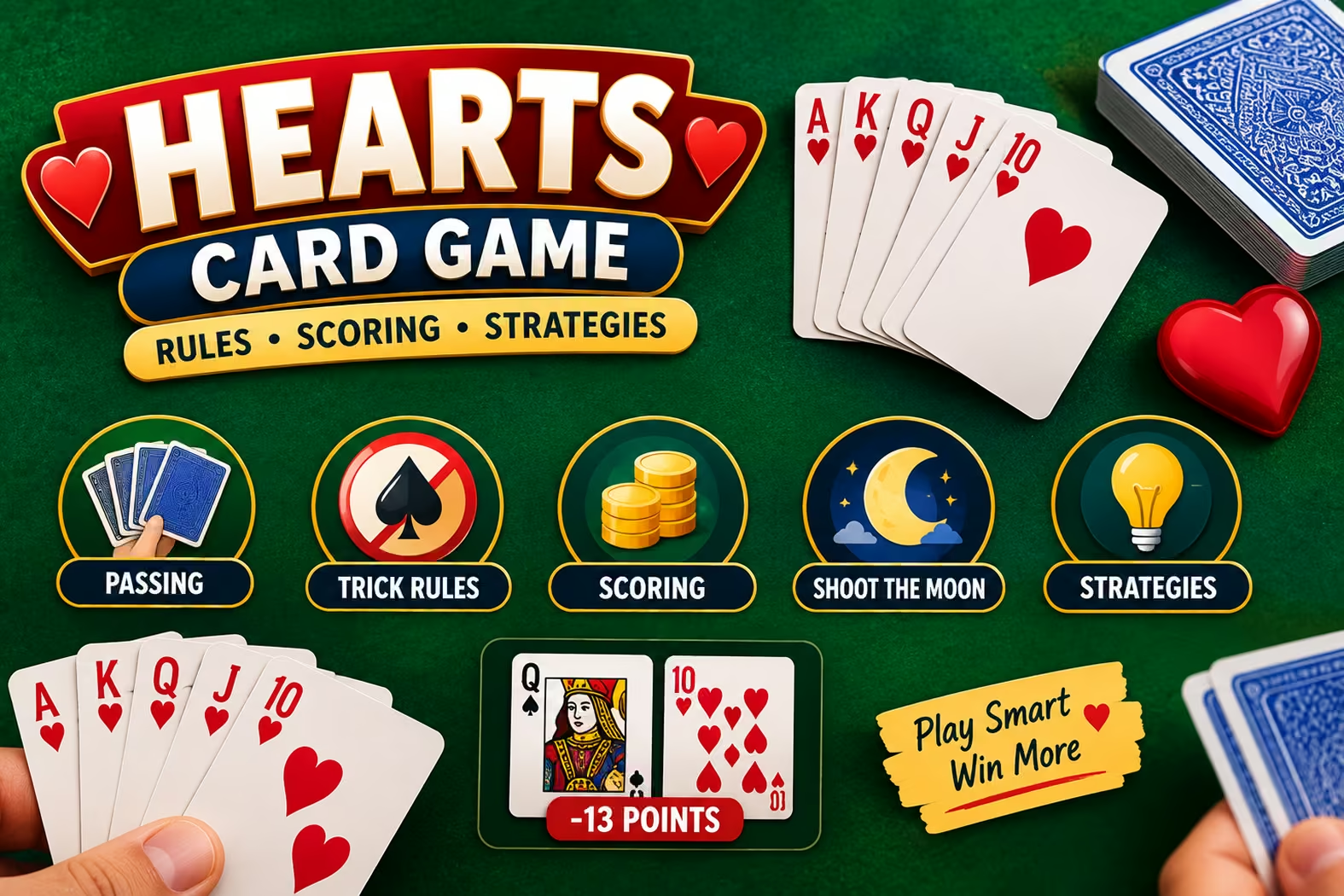
Hearts is a trick-taking card game where the goal is to avoid collecting penalty cards — specifically hearts (♥) and the Queen of Spades (Q♠). The player with the lowest score when someone hits 100 points wins.
| At a Glance | Detail |
|---|---|
| Players | 4 (standard) — 3 to 6 with variations |
| Deck | Standard 52-card deck — no Jokers |
| Cards dealt per player | 13 each |
| Goal | Have the lowest score when the game ends |
| End trigger | Game ends when any player hits 100 points |
| Penalty cards | All 13 hearts (♥) + Queen of Spades (Q♠) |
| Points per heart | 1 point each |
| Points for Queen of Spades | 13 points |
| Total penalty points possible | 26 (13 hearts × 1 point + Q♠ × 13 points) |
| Duration | 30–60 minutes |
| Best age | 8 and up |
What You Need to Play
- 1 standard 52-card deck — no Jokers
- Exactly 4 players for the standard game (see Section 10 for 3-player and other variants)
- Paper and pen to track scores across rounds
- About 30–60 minutes
How to Set Up the Game
- Shuffle the full 52-card deck thoroughly.
- Deal all 13 cards to each player, one at a time, face down, going clockwise. Every player gets exactly 13 cards.
- Players pick up and look at their cards privately.
- Before the first trick, the passing phase begins (see Section 4).
- After passing, the player holding the 2 of Clubs (2♣) leads the very first trick of the game.
How to Pass Cards — and Why It Matters
Before every round, each player passes exactly 3 cards face down to another player. The direction of passing rotates each round:
| Round | Passing Direction | Example |
|---|---|---|
| Round 1 | Pass to the LEFT | Your cards go to the player on your left |
| Round 2 | Pass to the RIGHT | Your cards go to the player on your right |
| Round 3 | Pass ACROSS | Your cards go to the player directly opposite you |
| Round 4 | NO PASS | Everyone plays with the hand they were dealt |
| Round 5+ | Repeat cycle (left, right, across, no pass) | Continues until game ends |
How to Play Tricks
Hearts is played in tricks. Each trick is one round where every player plays one card. Here is exactly how each trick works:
- The player holding 2♣ leads the very first trick — they must play the 2♣ as the lead card.
- Going clockwise, each other player must follow suit — play a card of the same suit as the lead card.
- If you have no card of the lead suit, you can play any card — including a heart or the Queen of Spades.
- The player who played the highest card of the lead suit wins the trick and takes all four cards.
- The winner of the trick leads the next trick — they can play any card, subject to the 'breaking hearts' rule.
- Continue until all 13 tricks are played (all 52 cards have been played).
- Count penalty cards collected and add to running totals.
The Breaking Hearts Rule
Hearts cannot be led — played as the first card of a trick — until 'hearts have been broken.' Hearts are broken when someone plays a heart card on a trick where they couldn't follow the lead suit.
| Situation | Can You Lead Hearts? |
|---|---|
| No heart has been played yet this round | No — you cannot lead hearts until they are broken |
| Someone has played a heart as a discard (off-suit) | Yes — hearts are now broken, you can lead hearts |
| You have ONLY hearts left in your hand | Yes — exception: you must lead hearts if it's all you have |
| You want to lead Queen of Spades | Yes — Q♠ does not count as 'hearts breaking' |
How Scoring Works
After all 13 tricks are played, count the penalty cards each player collected:
| Card | Points | Notes |
|---|---|---|
| Each heart card (♥2 through ♥A) | 1 point each | 13 hearts × 1 point = 13 total from hearts |
| Queen of Spades (Q♠) | 13 points | Single most dangerous card in the game |
| All other cards | 0 points | Clubs, Diamonds, Spades (except Q♠) = no penalty |
| Total possible penalty points | 26 points | 13 from hearts + 13 from Q♠ |
Worked Scoring Example
| Player | Hearts Taken | Q♠ Taken? | Round Score | Running Total |
|---|---|---|---|---|
| Arjun | 2 hearts | No | 2 points | 14 points |
| Priya | 5 hearts | Yes (Q♠) | 5 + 13 = 18 points | 47 points |
| Rohan | 3 hearts | No | 3 points | 28 points |
| Neha | 3 hearts | No | 3 points | 19 points |
| Total | 13 hearts | 1 Q♠ | 26 points total | (correct — all 26 accounted for) |
Shoot the Moon — What It Is and When to Try It
Shoot the Moon is the most dramatic play in Hearts. If you collect ALL 26 penalty cards in a single round — all 13 hearts AND the Queen of Spades — the scoring flips completely in your favour.
| Shoot the Moon Outcome | What Happens |
|---|---|
| You collect all 13 hearts + Q♠ (all 26 points) | You score 0 points — every opponent receives 26 points instead |
| OR (some house rules) | You subtract 26 from your own running total instead of adding to opponents |
| You try but fail (miss even one heart or Q♠) | You collect whatever penalty cards you took — possibly a very high score |
| Best time to attempt | When you have many high hearts + A♠ K♠ to control tricks |
| Worst time to attempt | When an opponent looks like they may also collect penalty cards |
When to Attempt Shoot the Moon
- You have at least 6 or 7 hearts in your hand — especially the high ones (A♥ K♥ Q♥ J♥).
- You have the Ace of Spades (A♠) or King of Spades (K♠) to control the Queen of Spades.
- You have enough high cards in other suits to win the tricks you need.
- Another player is far ahead in score — giving everyone 26 points would hurt them most.
When to Abandon a Shoot the Moon Attempt
- You realise you cannot win a key trick and another player is about to take hearts.
- Someone else is intentionally collecting hearts — they may be trying to shoot themselves.
- You're already in the lead (low score) — a failed shoot costs you dearly.
What to Pass and Why — Decision Guide
The passing phase is where experienced players gain their biggest edge. Here is exactly what to pass in each situation:
| Card / Situation | Pass It? | Why |
|---|---|---|
| Queen of Spades (Q♠) | Usually YES | Single most dangerous card — 13 points. Pass it unless you have A♠ K♠ J♠ to protect it |
| King of Spades (K♠) | Usually YES | If you don't have Q♠, K♠ can force you to take Q♠ from someone else's play |
| Ace of Spades (A♠) | Sometimes | A♠ always wins a Spade trick — dangerous if Q♠ is still in play |
| Ace of Hearts (A♥) | YES — almost always | Will win a heart trick — you don't want penalty points |
| High hearts (K♥ Q♥ J♥) | YES — priority | These will win heart tricks and collect penalty points |
| Low hearts (2♥ 3♥ 4♥) | Keep — generally safe | Low enough that others will likely win heart tricks before you |
| High Clubs / Diamonds (A♣ K♣ A♦ K♦) | Sometimes | Safe unless everyone is void in that suit — then you're forced to take a trick |
| Cards that complete a void | Prioritise | Emptying a suit from your hand lets you play hearts or Q♠ off-suit — very powerful |
Eight Winning Strategies
Strategy 1 — Track the Queen of Spades at All Times
The Q♠ is worth 13 points — half the total penalty in the entire round. Know who received it during passing. Watch Spade plays carefully. If you don't know where the Q♠ is, you can accidentally force someone to play it on a trick you win. Once Q♠ has been played, relax your Spade caution.
Strategy 2 — Create a Void in One Suit
If you have only 1 or 2 cards in a suit (say, Clubs), consider passing both to create a complete void. Once you're void in Clubs, every time Clubs are led, you can play any card — including hearts or the Q♠. This gives you enormous flexibility to dump dangerous cards on other players' tricks.
Strategy 3 — Don't Dump Q♠ Too Early
Many beginners play the Q♠ on the very first off-suit trick they get. This is often a mistake. Aim the Q♠ at the player who is currently winning (lowest score). Dumping it on the player who's already in last place helps no one. Wait for the right moment — when you can dump it on the right opponent.
Strategy 4 — Never Strip All Your High Cards
Never pass all your Aces and high cards away. If an opponent attempts Shoot the Moon and you have no high cards left, you cannot stop them. Keep at least one or two high cards in every suit to break up a potential moon shot.
Strategy 5 — Count Cards — Especially Spades
Track how many Spades have been played. If 10 Spades are gone and Q♠ hasn't appeared, the Q♠ is in one of the remaining 2 hands. Knowing this lets you completely avoid leading spades until the Q♠ is played. Card counting in Hearts is not complex — just track one suit at a time.
Strategy 6 — Lead Low Cards Early
In the first few tricks, lead low cards — 2s, 3s, 4s of safe suits. This does two things: it depletes opponents' hands of their safe cards, and it avoids triggering the Q♠ or breaking hearts before you're ready.
Strategy 7 — Form Temporary Alliances
Hearts has no formal teams, but informal cooperation happens naturally. When one player is far ahead (lowest score), the other three will naturally coordinate to give that player penalty cards. If you're in the lead, play conservatively. If you're behind, actively work to force cards onto the leader's tricks.
Strategy 8 — Know When the Game Is Over for This Round
If someone has successfully collected all hearts and the Q♠ (Shoot the Moon is complete), the round is over — don't try to take back points. Similarly, if you're clearly going to finish the round with 0 penalty cards, play the safest possible cards for the remaining tricks. Don't gamble when you're already winning a round.
Popular Hearts Variations
| Variation | Rule Change | How It Affects Play |
|---|---|---|
| Standard 4-Player (Default) | Standard rules as described above | Most balanced and strategic version |
| 3-Player Hearts | Remove 2♦ before dealing — each player gets 17 cards | Fewer cards make tracking easier; passing is the same |
| 5-Player Hearts | Remove 2♦ and 2♣ — each player gets 10 cards | Less information per player; faster rounds |
| 6-Player Hearts | Remove all four 2s — each player gets 8 cards | Short rounds, more luck, less strategy |
| Spot Hearts | Each heart is worth its face value (2♥=2pts, K♥=13pts) | Changes the risk calculation for individual hearts significantly |
| Jack of Diamonds | J♦ is a bonus card worth -10 points (subtracts from your score) | Adds a second special card to chase — changes passing strategy |
| Team Hearts | Two teams of two — share scores | Partners pass to each other; cooperation is key |
| Omnibus Hearts | Combines Jack of Diamonds bonus with standard rules | Most complex and strategic variant |
FAQs
What is the goal of Hearts?
The goal of Hearts is to have the lowest score when any player reaches 100 points. You score points by collecting hearts (1 point each) and the Queen of Spades (13 points) in tricks. Avoid these cards and you stay low. The player with the lowest total score at game end wins.
What is 'breaking hearts' in the card game Hearts?
Breaking hearts means a heart card has been played for the first time in the current round — usually as an off-suit discard when a player couldn't follow the lead suit. Once hearts are broken, any player can lead (start a trick with) a heart card. Before hearts are broken, you cannot lead hearts.
How many points is the Queen of Spades in Hearts?
The Queen of Spades is worth 13 points in Hearts — the highest single penalty card in the game. It equals half the total possible penalty points in a round (26 total). Collecting the Q♠ alone puts you in serious trouble unless you also collect all 13 hearts (Shooting the Moon).
What is Shooting the Moon in Hearts?
Shooting the Moon means collecting all 26 penalty cards in a single round — all 13 hearts AND the Queen of Spades. If you succeed, instead of scoring 26 points, every other player scores 26 points (or you subtract 26 from your own total, depending on house rules). If you try but fail, you score whatever penalty cards you collected normally.
Can you pass the Queen of Spades in Hearts?
Yes. Passing the Queen of Spades during the passing phase is completely legal and is actually a common defensive strategy. Many players pass it to avoid holding it themselves. Just be aware — if you pass Q♠ to a player who holds A♠ and K♠, they can protect it and control when it's played.
Who goes first in Hearts?
The player holding the 2 of Clubs (2♣) always goes first and must lead with the 2♣ as the opening card of the game. After that, the winner of each trick leads the next trick.